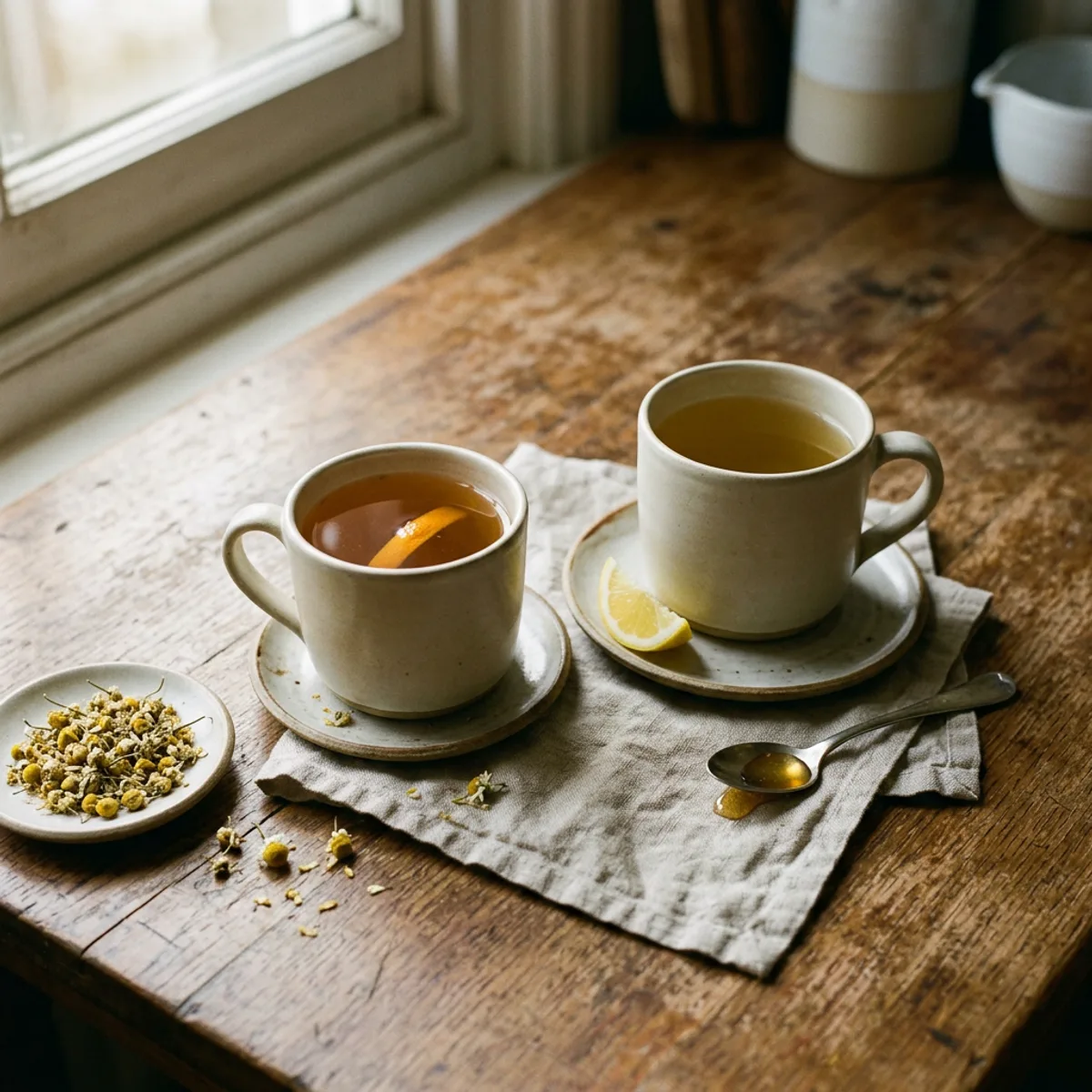
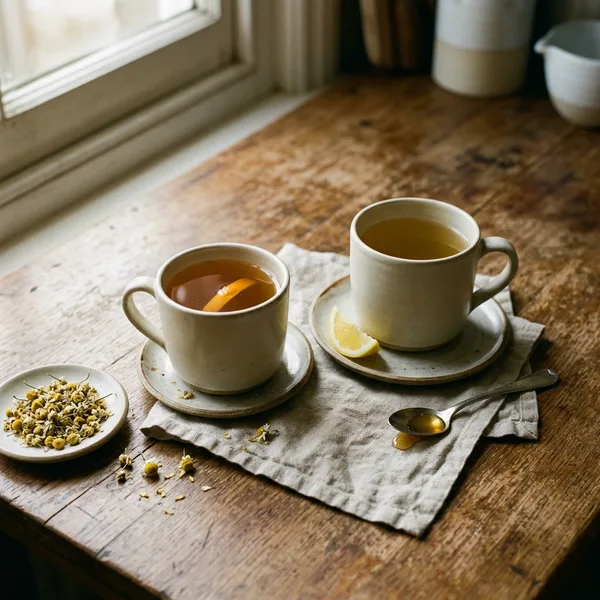
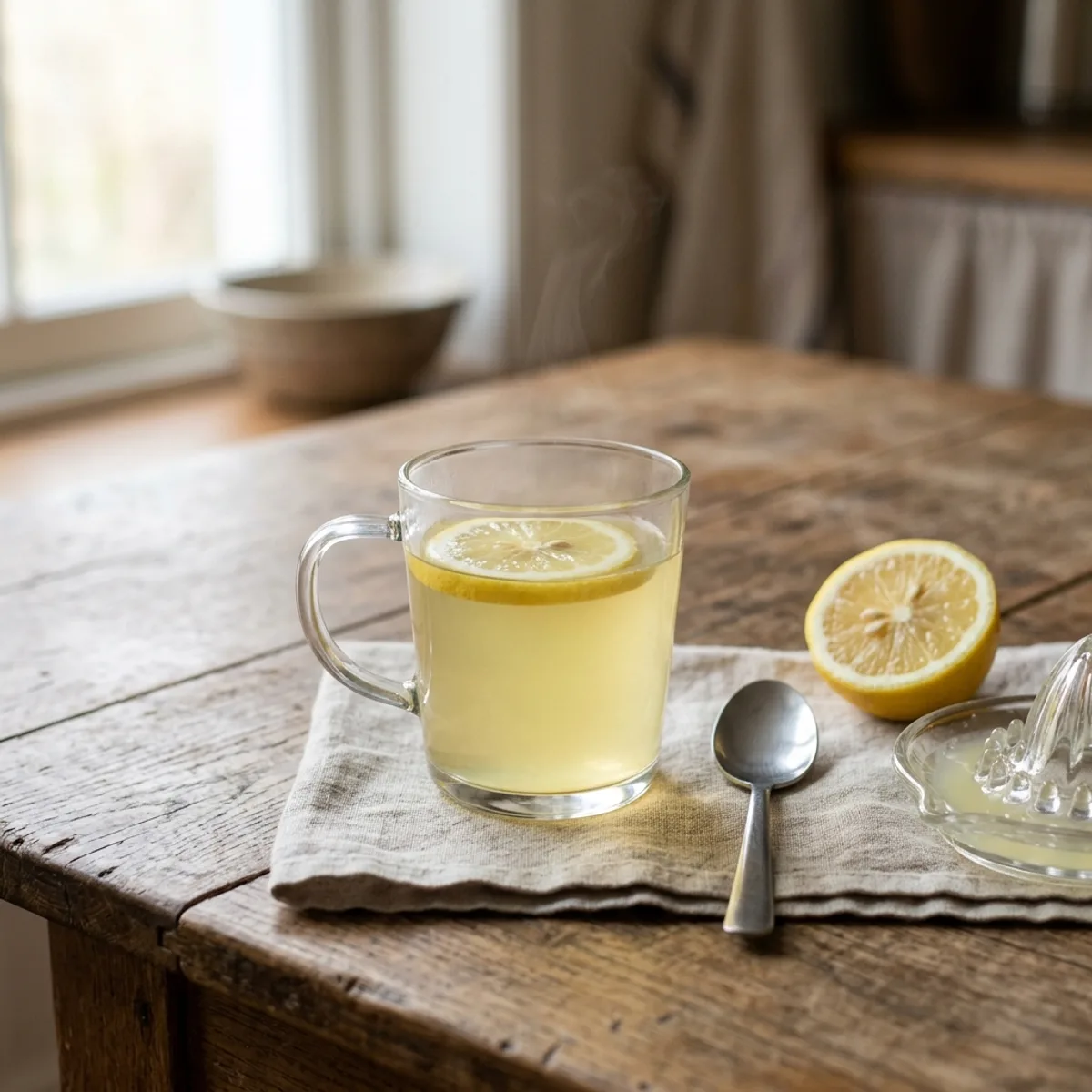
Chamomile tea is dried chamomile flowers steeped in water just off the boil for about 5 minutes. This mug adds orange peel, honey and lemon, for about 25 calories and no caffeine. For sleep, pooled trials show small gains, mostly fewer night awakenings rather than longer sleep. Jump to the recipe card.
Here is my twist. Plain chamomile can taste a little flat, like warm hay with a hint of apple. The orange peel fixes that. It adds a bitter-sweet top note that makes the flowers taste more like themselves, and the lemon lifts the whole mug. Two mugs, ten minutes, one pot to rinse.
Chamomile tea, four ways
| Version | What is in a mug | What studies show | Main caution |
|---|---|---|---|
| This hot mug (flowers, orange peel, honey, lemon) | About 25 calories, 0 mg caffeine (USDA) | Sleep quality improved modestly in pooled trials (PMID 39106912) | Skip it if you are allergic to ragweed or daisies (NIH) |
| Plain chamomile, nothing added | About 2 calories a cup (USDA) | Same evidence as above | Same as above |
| Iced, poured over ice | Same as the hot mug; the ice adds nothing | No study compared iced and hot chamomile | Same as above |
| Chamomile extract capsules | A concentrated dose, not a drink | Early studies of a supplement for anxiety, preliminary (NIH) | Ask your health care provider if you take any medicine (NIH) |
Nutrition figures come from USDA FoodData Central and are estimates.
What goes in the pot
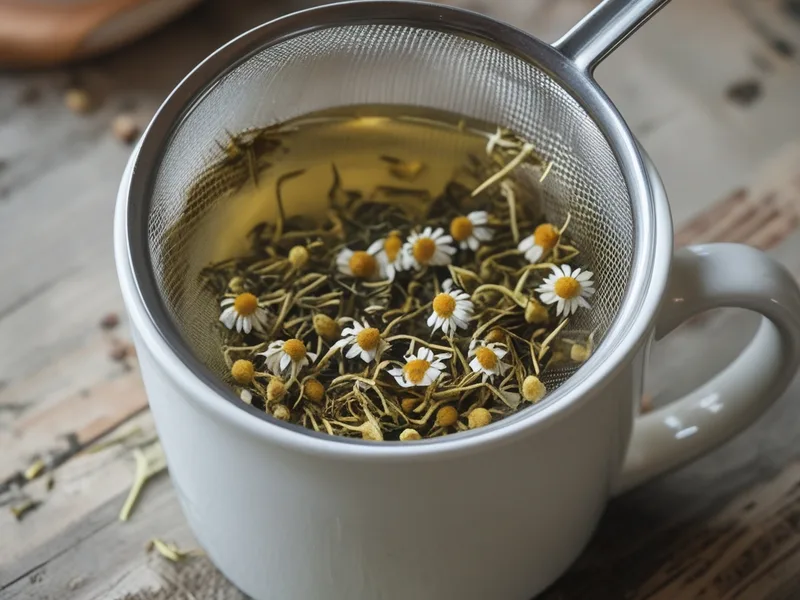
Dried chamomile flowers look like tiny dried daisies, yellow centres with a few white petals left on. Loose flowers give a fuller taste than most tea bags, and 1 tablespoon per cup is a good starting ratio. Tea bags work fine too; use one per mug.
The orange peel is the twist. Use a vegetable peeler on a washed orange and trim off any thick white pith, because the pith is what turns bitter. Lemon juice goes in at the end, never in the pot, so it stays fresh. Honey is optional and is where almost all the calories come from.
How to brew chamomile so it is not bland
Three things matter more than the brand of flowers.
- Water just off the boil. Boil it, then take it off the heat before the flowers go in. A rolling boil on the flowers makes the cup taste stewed.
- A lid. Cover the pot or put a saucer over the mug. The fragrance is the best part, and it leaves with the steam.
- Five minutes, then taste. Want it stronger? Add more flowers next time instead of steeping much longer: the flavor gets deeper, not harsher.
What to change if it tastes weak: more flowers. If it tastes bitter: less pith on the peel, or pull the peel out sooner. If it tastes sharp: half the lemon. The same lid-and-taste method works for the other caffeine-free cups in our best herbal tea guide.
Iced chamomile, and the chamomile iced tea benefits worth knowing
For iced tea, brew the recipe with double the flowers (4 tablespoons for 2 cups of water), because ice dilutes it. Let it cool on the counter, stir in the lemon, then pour it over a full glass of ice. Stir the honey in while the tea is still warm, or it will sink to the bottom. For a blue glass that turns violet with lemon, our iced butterfly pea flower tea is poured over ice the same way.
The honest chamomile iced tea benefits are the same as for the hot mug. It is a cold drink with no caffeine and very few calories, so it can stand in for a sweet iced tea or a soda on a hot afternoon. No study we read compared iced and hot chamomile, so neither one is better for sleep or anything else. If you want a tart, red pitcher instead, our iced hibiscus tea with lime works the same way.
Keep the iced tea covered in the fridge at 40°F (4°C) or below (USDA cold food storage chart) and drink it within a day or two, while it still smells fresh. That is our kitchen habit, not an official limit.
Chamomile tea for sleep: what the trials found
I read the abstracts of the trials and reviews that PubMed returns for chamomile with sleep, insomnia and anxiety. Here they are, one by one, with what they did not show.
- A 2024 meta-analysis of 10 clinical trials with 772 adults (PMID 39106912) found that chamomile improved scores on a standard sleep quality questionnaire. Its authors say the clearest effect was on waking up during the night and staying asleep. Sleep length, sleep efficiency and how people felt during the day did not improve, and the results varied a lot from trial to trial.
- A 2016 randomized trial in 80 Taiwanese women with poor sleep after giving birth (PMID 26483209) asked half of them to drink chamomile tea for 2 weeks. They reported fewer sleep problems linked to physical symptoms and fewer symptoms of depression than the women who got usual care. Four weeks later, both groups scored the same, so the effect did not last after they stopped.
- A 2019 meta-analysis of 12 randomized trials (PMID 31006899) found better sleep quality with chamomile, but no difference for anxiety in the pooled trials. Only one trial looked at insomnia, and it found no change in insomnia severity. The authors call for larger trials.
- A 2015 review of herbal medicines for insomnia (PMID 25644982), 14 trials with 1,602 people, found no herb, chamomile included, that did better than placebo on any of the 13 measures it looked at.
So chamomile tea for sleep is a modest story. A warm, caffeine-free mug in the evening may help some people wake up less at night, and that is about as far as the trials go. Most of the trials were small, only one in the 2024 review checked the purity or strength of the chamomile used, and the NIH notes that the single insomnia study in the 2019 review found no benefit. If poor sleep goes on for weeks, that is a conversation for your health care provider.
Benefits of drinking chamomile tea, without the hype
Let's sort the list you see everywhere into what holds up and what does not.
- What holds up: it has no caffeine and almost no calories. USDA lists 0 mg of caffeine and about 2 calories in a cup of brewed chamomile, so a plain mug is basically flavored water. That makes it an easy evening swap for a sugary drink.
- What has some trial support: sleep quality, modestly, as above. Some early studies of a chamomile supplement, not the tea, suggest it might help with generalized anxiety, according to the NIH.
- What is promoted but not shown: colds, coughs, indigestion and colic. The NIH says studies of chamomile for specific conditions have not produced enough reliable evidence to rate it, and that some of them tested mixes of several herbs.
The advantages of drinking chamomile tea at night
The main advantages of drinking chamomile tea at night are simple ones. There is no caffeine to fight with, it gives you something warm to sip that is not a dessert, and the ritual of making a pot is a cue to slow down. Pair the mug with a protein-rich evening snack if you are hungry; our high-protein overnight oats are ready the next morning too.
Make it your own
None of these went into Karim's pot on November 4: the recipe was made just as written, came together fast and without effort, and gave a delicious mug with exactly the feel Karim was after. Karim counts it as one to repeat.
- Ginger: add 3 thin slices of fresh ginger to the pot with the flowers for a warmer cup. If you love that flavor, our ginger water is built around it.
- Mint: a few fresh mint leaves in the pot make it brighter and greener. If mint is the flavor you want most, our peppermint tea is built around fresh and dried leaves.
- Creamy: skip the lemon (it can curdle milk) and top each mug with a splash of warm oat milk.
Safety: allergies, medicines and pregnancy
According to the NIH's National Center for Complementary and Integrative Health (chamomile fact sheet):
- Chamomile is likely safe in the amounts found in teas and foods. Side effects are uncommon and may include nausea, dizziness and allergic reactions, including severe ones (anaphylaxis).
- Allergies: allergic reactions are more likely if you are allergic to related plants such as ragweed, chrysanthemums, marigolds or daisies.
- Medicines: interactions have been reported with warfarin, a blood thinner, and with some drugs processed by the liver, and there are theoretical reasons to expect interactions with sedatives. If you take any medicine, check with your health care provider first.
- Hormones: chamomile might act a little like estrogen. Early studies suggest it might lower the effect of birth control pills, and it might worsen conditions sensitive to estrogen, such as breast or uterine cancer.
- Pregnancy and breastfeeding: little is known about whether chamomile is safe, so ask your health care provider before making it a habit.
A cup of tea is a drink, not a treatment. Talk to your health care provider before using it for a health problem.
How we researched this
- Nutrition: from USDA FoodData Central for brewed chamomile tea, honey and lemon juice, added up ingredient by ingredient. The orange peel is lifted out before serving and is not counted, so the totals are estimates.
- Studies: a PubMed search on November 3, 2026 for trials and reviews on chamomile with sleep, insomnia and anxiety; we read the full abstracts of the four studies cited above.
- Safety and history: the NCCIH chamomile fact sheet, read on November 3, 2026.
Chamomile Tea With Honey, Lemon and an Orange-Peel Twist
A five-minute mug of chamomile with a strip of orange peel, honey and lemon, served hot or over ice, with what sleep trials and the NIH actually say.
Ingredients
Instructions
- Steep the chamomile. Bring 2 cups (475 ml) of water to a boil and take it off the heat. Add the dried chamomile flowers (or the tea bags) and the strip of orange peel, cover, and steep for 5 minutes.

- Strain. Pour the tea through a fine strainer into two mugs and throw away the flowers and the peel. With tea bags, just lift them out and squeeze them gently against a spoon.
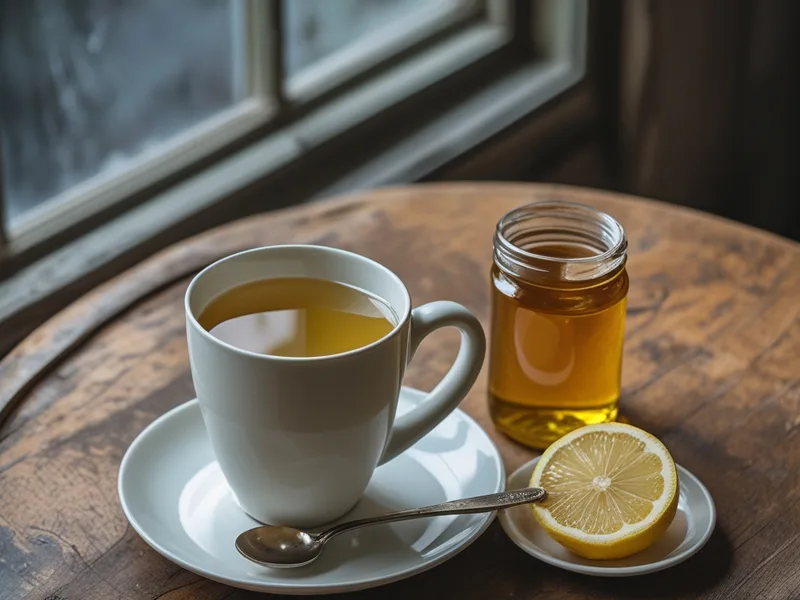
- Finish with honey and lemon. Stir 1 tsp of honey, if you use it, and 1 tsp of lemon juice into each mug while the tea is hot. Taste, and add a few more drops of lemon if you want it brighter.
Notes
Keep the lid on while it steeps: the steam carries a lot of the apple-like smell of the flowers.
Five minutes gives a soft, round cup. Go to 7 or 8 minutes for a stronger one, but the orange peel turns bitter if it sits much longer, so lift it out at 5.
Skip the honey and each mug drops to a few calories.
Nutrition Facts
Per serving (estimated)
- Total Fat
- 0 g
- Sodium
- 3 mg
- Total Carbohydrate
- 7 g
- Protein
- 0 g
General information, not medical or dietary advice. Nutrition values are estimates. See our full disclaimer.
Frequently asked questions
What are the benefits of chamomile flowers?
Chamomile flowers make a caffeine-free, nearly calorie-free tea, which is a real everyday benefit. Trials have looked at sleep quality and anxiety with mixed and modest results, and the NIH says the evidence is not yet strong enough to rate chamomile as useful for specific conditions.
When to drink chamomile tea, morning or night?
Either works: USDA data list no caffeine in brewed chamomile, so it will not keep you up like coffee or black tea. Most people save it for the evening because of its reputation for sleep, which the trials below only partly support.
What is the origin and history of chamomile tea?
According to the NIH, chamomile appears in ancient medical writings and was an important medicinal herb in ancient China, Egypt, Greece and Rome. The tea sold today is usually German chamomile, Matricaria chamomilla.
Is chamomile tea good for a cough?
Chamomile is promoted for coughs and colds, but the NIH says studies have not produced enough reliable evidence to rate it for any specific condition. A warm mug can be soothing to sip; a cough that lasts or comes with fever needs a health care provider, not a tea.


Comments
Tried it? Tell us how it went: your comment helps other readers.