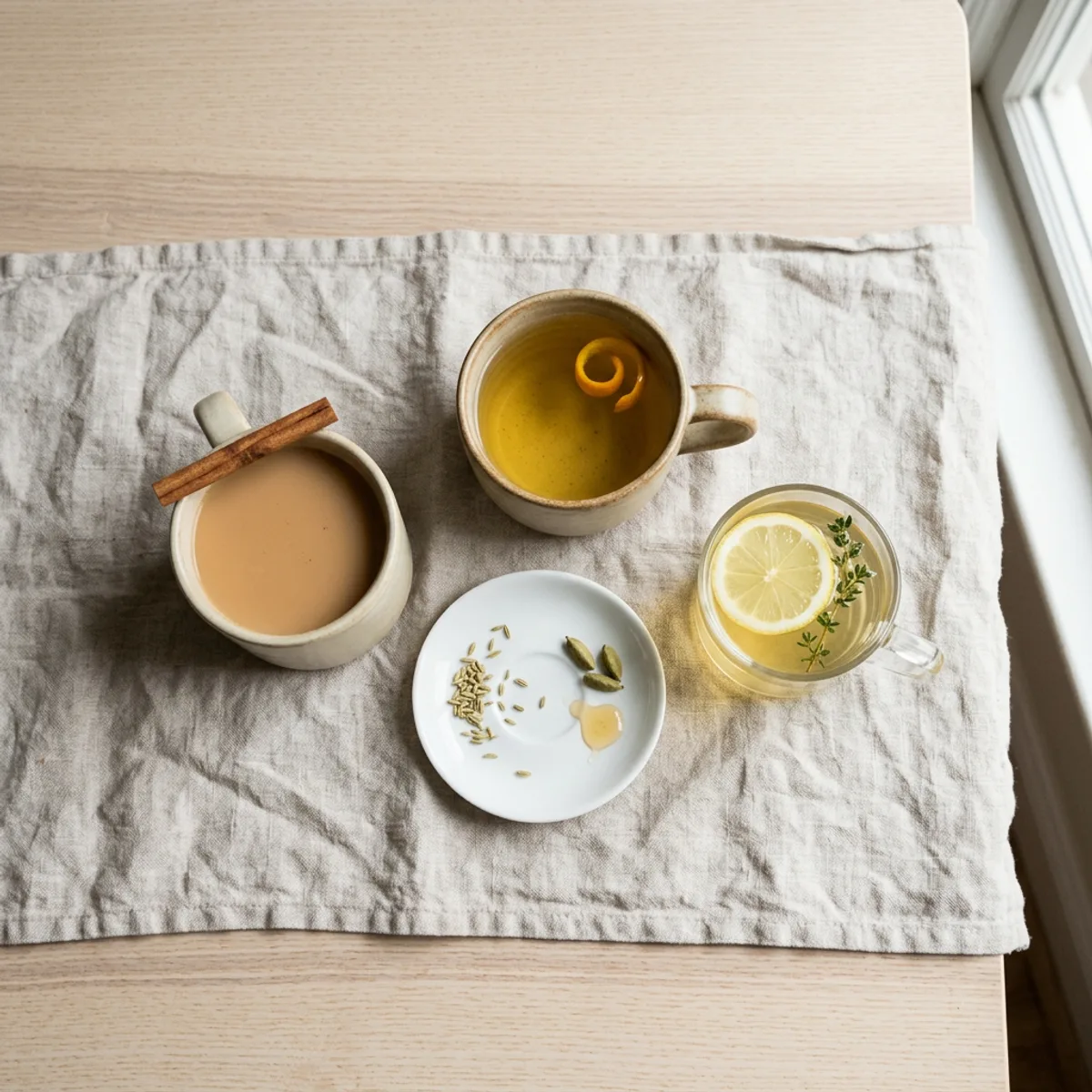
The best herbal tea is the one that fits the moment you drink it: chamomile before bed, peppermint or fennel after a meal, ginger or thyme on a cold morning, hibiscus over ice, and rooibos when you miss chai. All are caffeine-free, and plain they have about 2 calories a cup by USDA data. Three full recipes are below.
Taste an herbal tea the way a cook tastes a broth: the first sip, the middle, the finish. A good cup is clear at all three. A tired one is flat at the front and bitter at the end. Most of the difference comes from two details you control, the water temperature and the lid, and I come back to both in the brewing section.
The best herbal tea for each moment: eight compared
| Tea | Flavor | Best moment | What human studies tested | Main caution |
|---|---|---|---|---|
| Chamomile | Soft, apple-like, floral | Before bed | 10 trials pooled: better sleep quality scores and fewer night awakenings, but no longer sleep (PMID 39106912) | Allergy risk if you react to ragweed, daisies or marigolds (NIH) |
| Peppermint | Cool, sharp, sweet finish | After dinner | Oil capsules, not tea: fewer IBS symptoms than placebo, with very low-quality evidence (PMID 35942669) | Peppermint oil can cause heartburn (NIH) |
| Ginger | Hot, peppery | Cold mornings | Mostly supplements: may help nausea in pregnancy (NIH); no clear effect on chemotherapy nausea (PMID 36501010) | Heartburn, stomach discomfort (NIH) |
| Hibiscus | Tart, berry-like | Iced, in the afternoon | 13 trials: lower blood pressure than placebo in mild to moderate high blood pressure (PMID 34694241) | Ask your health care provider first if you take medicine (NIH) |
| Rooibos | Malty, woody, lightly sweet | Evening chai | The only review in our search pooled studies in diabetic rodents (PMID 29642387) | Same rule for medicines as every herb (NIH) |
| Fennel | Sweet, anise-like | After a meal | Seed oil emulsion in colicky babies, not tea in adults (PMID 12868253) | Never give an herbal product to a baby without the pediatrician |
| Thyme | Savory, warm, a little like oregano | Cold mornings | Dried leaf capsules in students (PMID 38039009) and a syrup in children with asthma (PMID 38186189) | Same rule for medicines as every herb (NIH) |
| Cinnamon | Warm, sweet | In chai or with apple | Supplements: a small drop in diastolic pressure, under 1 mm Hg (PMID 32727334) | Cassia cinnamon contains coumarin; long use may be a problem with liver disease (NIH) |
Calories and caffeine come from USDA FoodData Central. "NIH" means the fact sheets of the National Center for Complementary and Integrative Health, listed in the safety section.
What the evidence says about herbal tea benefits
Herbal tea benefits are easy to overstate, because most trials did not give anyone a mug of tea. They tested extracts, capsules, oils or syrups at set doses. Here is what the studies we read found, abstract by abstract, and where each one stops.
- Chamomile and sleep. A 2024 meta-analysis of 10 trials with 772 participants (PMID 39106912) found a better score on a standard sleep quality questionnaire and, in two of three studies, fewer awakenings at night. Sleep did not get longer, sleep efficiency did not improve, and daytime tiredness did not change. The NIH adds that the one trial on insomnia found no benefit.
- Chamomile and anxiety. A 2019 review of 12 randomized trials (PMID 31006899) found no difference from placebo for anxiety in three trials, a small improvement in generalized anxiety disorder after 2 and 4 weeks, and better sleep quality. The authors ask for larger trials.
- Hibiscus and blood pressure. A 2022 meta-analysis of 13 randomized trials with 1,205 participants (PMID 34694241) found that hibiscus lowered systolic pressure by 6.67 mm Hg and diastolic pressure by 4.35 mm Hg more than placebo in people with mild to moderate high blood pressure. It did no better than blood pressure drugs and had no clear effect in people with metabolic syndrome.
- Peppermint oil and IBS. A 2022 meta-analysis of 10 trials with 1,030 patients (PMID 35942669) found the oil better than placebo for overall IBS symptoms and belly pain, with more side effects and evidence of very low quality. The NIH says very little research has been done on the leaf, which is what goes into tea.
- Ginger and nausea. A 2022 review of 23 trials in people on chemotherapy (PMID 36501010) found no overall difference in nausea or vomiting with ginger supplements. One subgroup, taking no more than 1 g a day for more than four days, had less early vomiting.
- Rooibos. The only meta-analysis our search returned (PMID 29642387) pooled 12 studies in diabetic rodents. Nothing in it can be said of people drinking rooibos.
- Thyme. One trial gave 106 university students 500 mg of dried thyme leaves twice a day for a month (PMID 38039009) and found better scores for memory, anxiety and depression, though not for the time it took to fall asleep or how long they slept. Another gave a thyme syrup to 60 children with asthma for a week, alongside their usual treatment (PMID 38186189), and found less cough on activity. Both are single, small trials of a measured dose.
- Fennel. The fennel trial in our search (PMID 12868253) tested a seed oil emulsion in 125 babies with colic. It tells you nothing about a cup for an adult.
- Cinnamon. A 2021 meta-analysis of 8 trials with 582 adults taking cinnamon supplements (PMID 32727334) found no change in systolic pressure and a drop of 0.93 mm Hg in diastolic pressure. The NIH says research does not clearly support cinnamon for any health condition.
The plain reading: chamomile and hibiscus have the most human trials behind them, and even those used measured doses. Choose the best herbal tea for its flavor and its lack of caffeine. Treat any effect beyond that as a possibility, not a promise.
Best herbal tea for weight loss: which one to drink to lose weight?
None of the sources we read shows that an herbal tea makes you lose weight. The NIH says it is unclear whether cinnamon supplements help with weight loss, and no trial in our search tested chamomile, peppermint, rooibos, fennel or thyme tea on body weight.
What a plain herbal tea can do is replace a sweet drink. According to the CDC, sugary drinks are the leading source of added sugars in the American diet, a 12-ounce regular soda has about 42 grams of added sugar, about 150 calories, and cutting two regular sodas a day removes 2,100 calories in a week. The CDC names unsweetened tea among its alternatives to energy drinks, and counts sugar or flavored creamer added to tea at home as a sugary drink. A cup of plain brewed herbal tea has about 2 calories by USDA data.
So the best herbal tea to drink for weight loss is simply the one you enjoy enough to drink unsweetened, often, instead of soda or juice. If you also want caffeine, our green tea for weight loss page looks at the research on green tea, a true tea with caffeine, and gives an iced recipe.
How to brew herbal tea so it tastes clean
Even the best herbal tea tastes flat if it is brewed carelessly. Mise en place first: kettle, a teapot or heatproof jug with a lid, a fine strainer, the mugs warming with a splash of hot water.
- Water just off the boil. Let it rest for about 30 seconds after the kettle clicks. Herbal tea takes hotter water than green tea.
- Cover the pot at once. The aroma of mint, chamomile or fennel is volatile. Without a lid it goes into the room, not the cup.
- Leaves and flowers: 5 to 7 minutes. Roots, seeds and bark: simmer. Ginger, cinnamon and cardamom give little in a short steep; a gentle simmer opens them.
- For a stronger cup, use more, not longer. Extra minutes pull out bitterness before they add flavor.
- Taste at the low end of the time. Then strain. The leaves keep working as long as they sit in the water.
The one detail that matters most is the lid. It keeps the aroma in the cup, and aroma is most of what an herbal tea has to give.
Rooibos chai with soy milk
Rooibos is not made from the tea plant, and like the other herbal teas here it has no caffeine by USDA data. Its malty, woody taste stands up to spices the way black tea does, which makes it the best base I know for an evening chai. Unsweetened soy milk gives the body of a latte and brings protein that water alone does not.
Makes 2 mugs. Prep 5 minutes. Cook 13 minutes.
Ingredients
- 1 1/4 cups (300 ml) water
- 2 rooibos tea bags or 2 teaspoons loose rooibos
- 1 cinnamon stick
- 4 green cardamom pods, lightly crushed
- 3 thin slices fresh ginger
- 4 black peppercorns
- 1 1/2 cups (360 ml) unsweetened soy milk
- 2 teaspoons maple syrup, or to taste
Steps
- Toast the spices. Put the cinnamon stick, cardamom pods and peppercorns in a small dry saucepan over medium heat for about 1 minute, until you can smell them.
- Simmer the spices, then the rooibos. Add the water and ginger, bring to a simmer and cook for 5 minutes. Add the rooibos, take the pan off the heat, cover and steep for 5 minutes. You should have about 1 cup (240 ml) of dark, spiced tea.
- Add the soy milk and finish. Pour in the soy milk and warm it over low heat until steaming, without letting it boil hard. Strain into two mugs and stir 1 teaspoon of maple syrup into each.
Per mug: about 79 calories, 5 g protein, 8 g carbohydrate, 3 g fat, 69 mg sodium, 0 mg caffeine. Without the maple syrup: about 61 calories.
Storage: keep leftover chai covered in the fridge and drink it within a day, a kitchen habit rather than an official limit. Shake or whisk it before reheating, because soy milk can settle.
On a morning when you do want caffeine in a creamy mug, our matcha latte recipe whisks green tea powder into warm milk instead.
Fennel and orange-peel tea
A good cup after a rich meal. Crushed fennel seeds give a sweet, anise-like flavor with no sugar added, and a strip of orange peel lifts it. It tastes sweeter than it is.
Makes 2 mugs. Prep 3 minutes. Cook 8 minutes.
Ingredients
- 2 1/4 cups (530 ml) water
- 2 teaspoons fennel seeds
- 1 strip orange peel, about 3 inches (7 cm), white pith trimmed off
Steps
- Crush the seeds. Press the fennel seeds with the flat of a knife or in a mortar until they crack open. Whole seeds give a weak, watery cup.
- Simmer, then steep. Bring the water and seeds to a simmer for 3 minutes. Add the orange peel, take the pan off the heat, cover and steep for 5 minutes.
- Strain and serve. Pour through a fine strainer into two mugs. Taste before you sweeten: most people find it sweet enough as it is.
Per mug: about 2 calories, 0 mg caffeine, 2 mg sodium. One teaspoon of honey adds about 21 calories.
Storage: best fresh. Leftovers keep covered in the fridge for a day and are good over ice.
Fresh thyme tea with lemon and honey
Thyme makes a savory, warming tea, close to a light broth in feeling. Fresh sprigs are cleaner than dried; dried thyme can turn dusty and harsh. Lemon and a little honey round it off.
Makes 2 mugs. Prep 3 minutes. Cook 7 minutes.
Ingredients
- 2 cups (475 ml) water
- 6 sprigs fresh thyme, rinsed
- 2 teaspoons honey
- 2 teaspoons lemon juice
- 2 thin lemon slices, to serve
Steps
- Bruise the thyme. Roll the sprigs once under your palm on the board to wake up the oils.
- Steep covered. Bring the water to a boil, rest it for 30 seconds, and pour it over the thyme in a teapot or jug. Cover and steep for 6 minutes. Taste at 5.
- Finish. Strain into two mugs. Stir 1 teaspoon of honey and 1 teaspoon of lemon juice into each, and add a lemon slice.
Per mug: about 25 calories, 7 g carbohydrate, 3 mg sodium, 0 mg caffeine.
Storage: drink it fresh; the thyme turns bitter if it sits in the pot.
Two more of the best herbal tea recipes from our kitchen
For a cold drink, our iced hibiscus tea with lime brews the deep red flowers in hot water and chills them into a tart pitcher. For heat in the cup, the ginger water with lemon simmers sliced fresh ginger, and its page sets out what ginger can and cannot do.
Safety: who should be careful
Herbal teas are food, but the plants in them are not neutral. These points come from the NIH's National Center for Complementary and Integrative Health (chamomile, peppermint oil, ginger and cinnamon fact sheets):
- Medicines: if you take any medicine, talk with your health care provider before using herbal products, because some herbs and medicines interact in harmful ways. For chamomile, the NIH notes reported interactions with warfarin (a blood thinner) and some drugs processed by the liver, and a theoretical one with sedatives.
- Chamomile: likely safe in the amounts found in tea. Allergic reactions, rarely severe, are more likely if you are allergic to ragweed, chrysanthemums, marigolds or daisies. It might act a little like estrogen, may make birth control pills less effective, and might worsen conditions sensitive to estrogen.
- Peppermint: peppermint tea appears to be safe, though the long-term safety of large amounts of the leaf is unknown. Peppermint oil taken by mouth can cause heartburn, nausea, belly pain and dry mouth. Menthol should not be inhaled by or put on the face of an infant or small child.
- Ginger: can cause belly discomfort, heartburn, diarrhea and mouth or throat irritation. Ginger supplements in pregnancy may be safe, but ask your health care provider first.
- Cinnamon: cassia, the most common type in North America, contains coumarin; some products have high levels, and long use could be an issue for people with liver disease. Ceylon cinnamon in large amounts is considered unsafe in pregnancy. The amounts used as a spice are likely safe.
- Pregnancy and breastfeeding: little is known about chamomile in pregnancy or while breastfeeding, and little about ginger while breastfeeding. Ask your health care provider before drinking any herbal tea every day.
- Babies: the fennel and chamomile studies in babies used measured extracts. Do not give a baby any herbal tea or product unless the pediatrician says so.
A cup of tea is not a treatment. For sleep problems, anxiety, high blood pressure or digestive symptoms that keep coming back, see your health care provider.
What we read, and how we counted
- Nutrition: USDA FoodData Central for brewed herbal tea other than chamomile, used for the rooibos, fennel and thyme brews because USDA has no separate entry for them, unsweetened soy milk, maple syrup, honey and lemon juice. Spices, seeds, sprigs and peels are strained out and not counted, so every total is an estimate.
- Studies: PubMed searches on November 4, 2026 for reviews and trials of chamomile, peppermint, ginger, hibiscus, rooibos, fennel, thyme and cinnamon with sleep, anxiety, digestion, nausea and blood pressure. We read the abstract of every study cited above.
- Official sources: the NIH (NCCIH) fact sheets on chamomile, peppermint oil, ginger and cinnamon, and the CDC page on sugary drinks, all read on November 4, 2026.
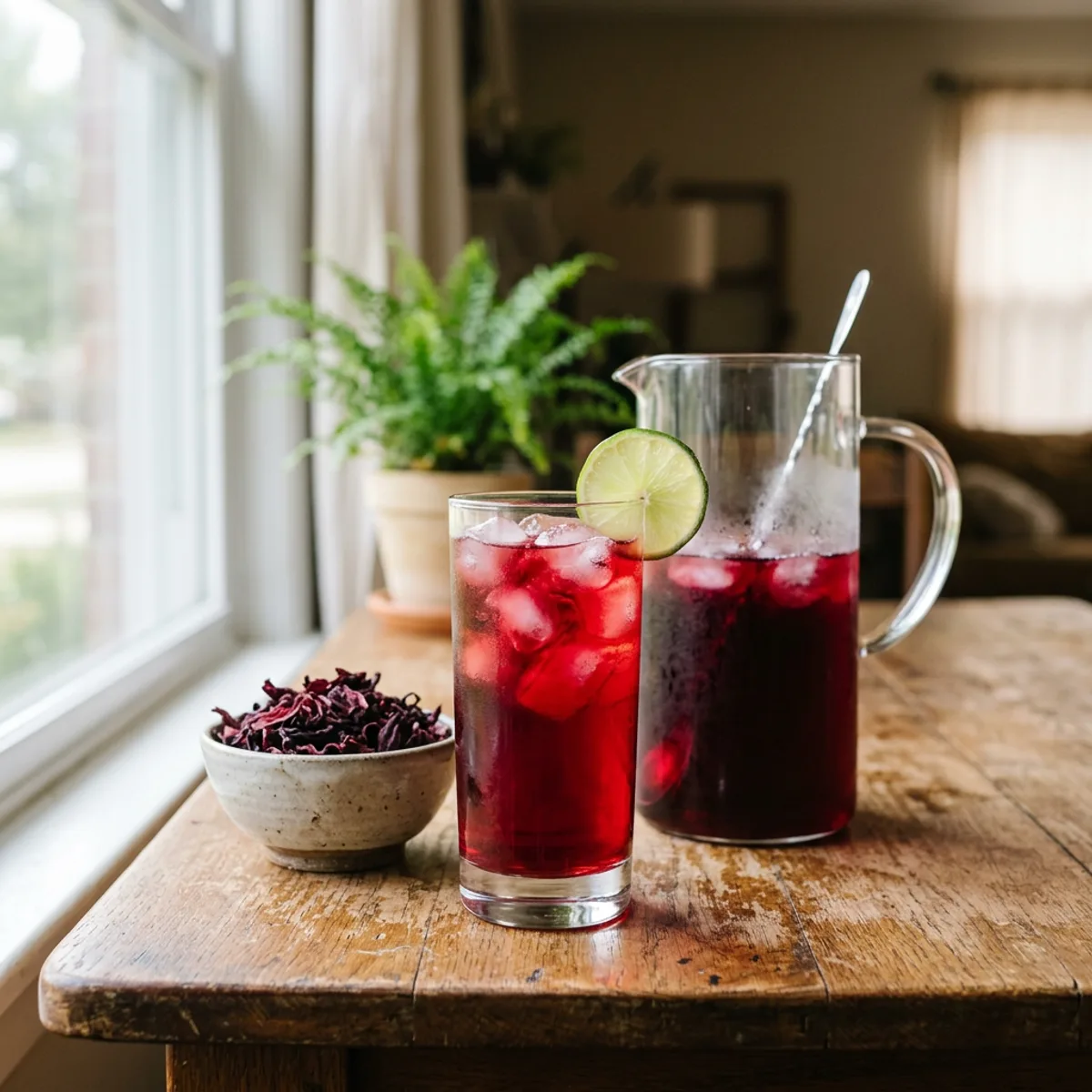
Iced Hibiscus Tea With Lime and Honey
The tart, ruby-red pick for a warm afternoon, and the herbal tea with the most blood pressure trials behind it.
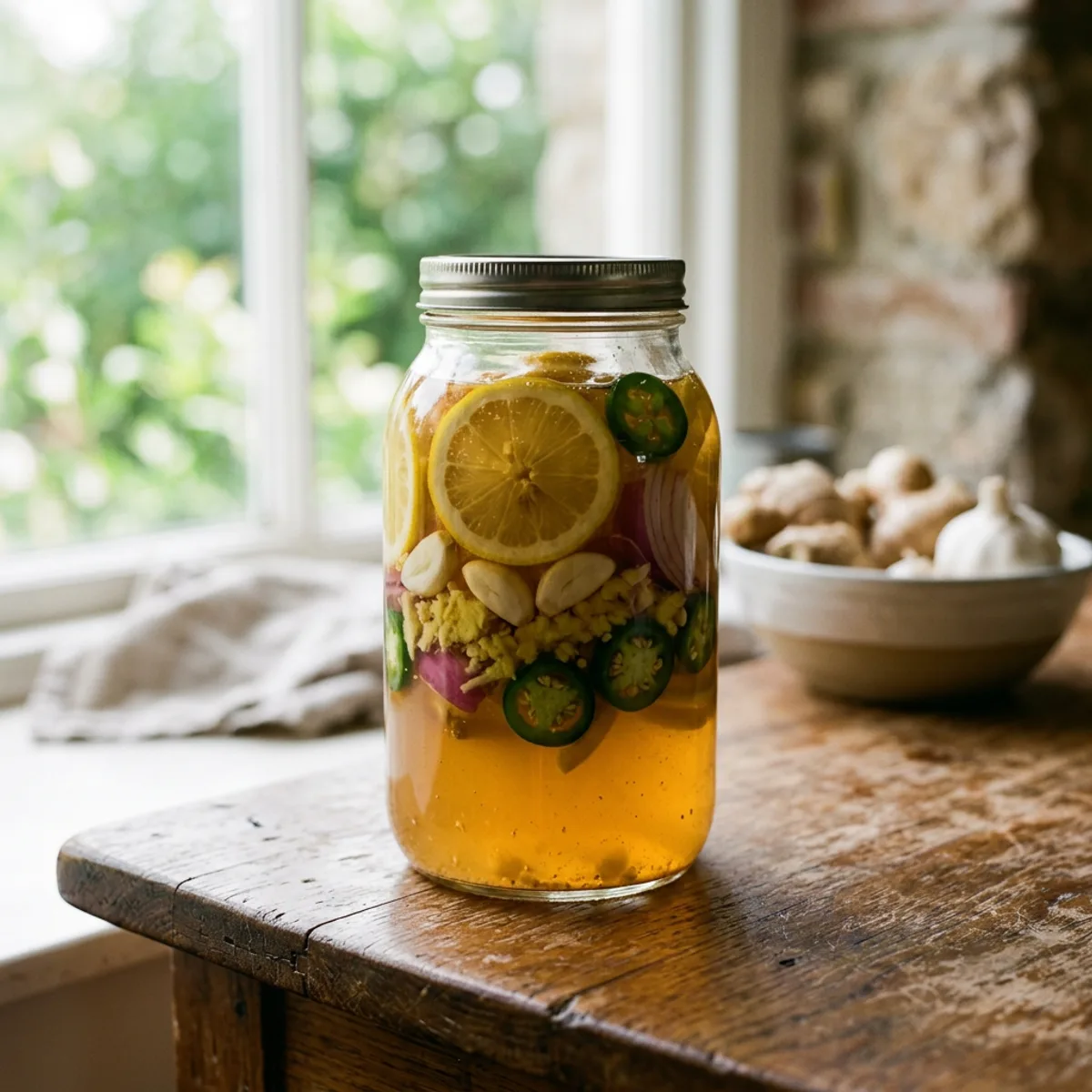
Ginger Water (Ginger Tea) With Lemon
Sliced fresh ginger simmered in water, for the mornings when you want heat in the cup.
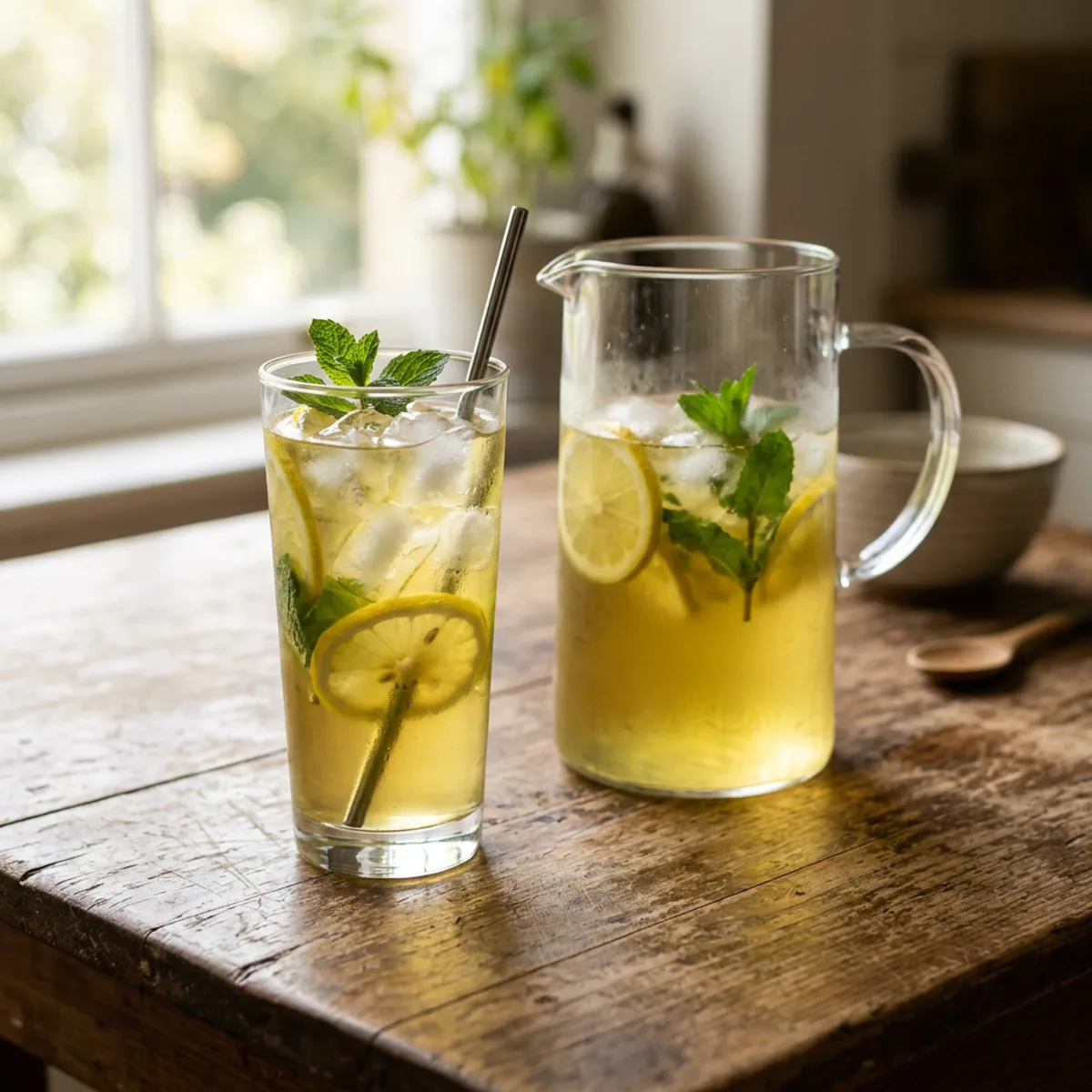
Iced Lemon-Mint Green Tea
Not an herbal tea but a true tea, for the afternoons when you want a little caffeine with your mint.
General information, not medical or dietary advice. Nutrition values are estimates. See our full disclaimer.
Frequently asked questions
What is the healthiest herbal tea?
No herbal tea is the healthiest for everyone. Plain, any of them is a caffeine-free drink of about 2 calories a cup by USDA data. Which one suits you depends on taste, timing and your health: hibiscus, for example, has the most blood pressure trials, but that matters most if your doctor is already watching your pressure.
What is the most effective herbal tea?
It depends on the effect. Pooled trials found better sleep quality scores with chamomile, lower blood pressure with hibiscus in mild to moderate high blood pressure, and fewer IBS symptoms with peppermint oil capsules. Most of these trials used extracts or capsules rather than a mug of tea, so treat them as a reason to enjoy the tea, not as treatment.
What are the top 5 healthy teas?
There is no official ranking. For a caffeine-free shelf we would start with chamomile for the evening, peppermint or fennel after dinner, ginger on cold mornings, hibiscus iced in summer and rooibos when you miss chai. If you want caffeine, green tea is a true tea from the tea plant, not an herbal one.
What tea stops anxiety?
No tea stops anxiety. In a 2019 review of chamomile trials, three trials on anxiety showed no difference from placebo, while people with generalized anxiety disorder improved a little after 2 and 4 weeks of chamomile. If anxiety affects your days, talk with a doctor or mental health professional.
Are these herbal tea recipes hard to make?
Not in Alin's kitchen. Brewed on November 4 with nothing changed from the page, it came together fast and without fuss, the cup had exactly the body Alin wanted and tasted delicious, and it is staying on Alin's list.
Is herbal tea caffeine-free?
A true herbal tea is. USDA lists 0 mg of caffeine in a cup of brewed herbal tea. Read the label of any blend, though: some herbal mixes include black or green tea, which bring caffeine back in.
Comments
Tried it? Tell us how it went: your comment helps other readers.