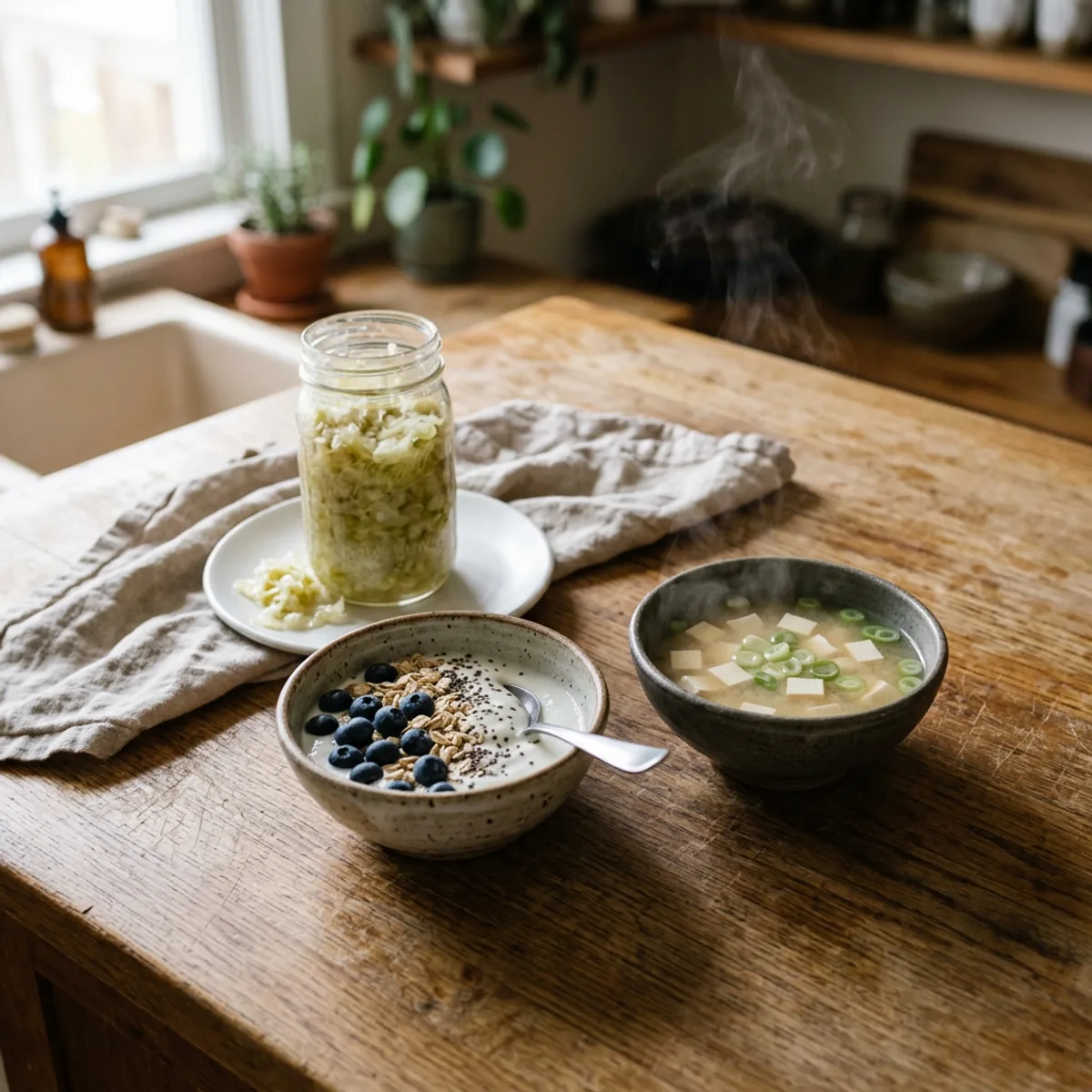
Fermented foods for gut health: are they worth it? Possibly. Harvard Health lists them as probiotic sources, and one 17-week trial of 36 healthy adults found that a high-fermented-food diet raised microbiome diversity. It is a small trial, and the only one of its kind we read. Three recipes to start with:
| Recipe | What it is built on | Per serving |
|---|---|---|
| Homemade sauerkraut | Green cabbage and salt, fermented 3 to 4 weeks | 28 calories, 2.8 g fiber, up to 1,040 mg sodium |
| Kefir bowl with blueberries and oats | Plain kefir, frozen blueberries, rolled oats, chia | 306 calories, 15 g protein, 8.5 g fiber |
| Miso soup with tofu and scallions | White miso, silken tofu, scallions | 101 calories, 9 g protein, 680 mg sodium |
With fermented foods for gut health, I'd rather you make one real jar of sauerkraut than buy a bottle of something with a probiotic label. Fermenting is cheap, it needs two ingredients, and you learn what the food should really taste like: sharp, clean, a little sour, never musty. The other two recipes start from foods you can buy already fermented, so the work is in choosing well.
Are fermented foods good for gut health? What the trials show
Be honest first: the evidence on fermented foods is thin. "Gut health" in the studies below means microbiome diversity, inflammatory blood markers or digestive symptoms, measured after people ate a food for hours or weeks. Here is what we read on PubMed, and where each study stops.
- A diet high in fermented foods. In a randomized trial at Stanford (PMID 34256014), healthy adults followed one of two diets for 17 weeks, 18 people in each arm: a high-fiber diet or a high-fermented-food diet. The fermented-food diet steadily increased microbiota diversity and decreased inflammatory markers. The high-fiber diet did not change diversity in that trial, though it changed the microbiome's enzymes. The authors suggest that fermented foods may help counter the low diversity and higher inflammation common in industrialized societies. The limits are plain: 36 healthy adults, 17 weeks, and no result for people with a digestive condition.
- Kefir and lactose. A 2003 trial (PMID 12728216) gave 15 adults who digest lactose poorly a test meal with 20 g of lactose as milk, kefir or yogurt. Breath hydrogen, a sign of undigested lactose, was far lower after plain kefir (87 ppm x h) than after milk (224 ppm x h). Yogurts and kefirs cut the perceived severity of flatulence by 54 % to 71 % compared with milk. Flavored kefir did less than plain kefir (156 ppm x h). It was a single meal in 15 people, and the authors call for more studies.
- What we did not find. Nothing we read shows that sauerkraut, kimchi or miso improve gut health on their own; the two trials above cover a whole diet and kefir. Harvard Health says the same thing in other words: probiotic foods are promising, and the research is not settled.
So fermented foods for gut health earn a place on the plate as one part of a varied diet, not as a fix. The fiber side of the same gut story is on our high fiber foods page, and the wider eating pattern in our anti-inflammatory diet guide.
Top 10 fermented foods for gut health
Harvard Health's page "How to get more probiotics" (January 29, 2025) names these ten foods as sources of probiotics, and we keep to its list rather than adding ours:
- Yogurt: Harvard calls it the go-to probiotic food; look for "live and active cultures" on the label.
- Kefir: a drinkable cultured milk, used in the bowl below.
- Kombucha: fermented tea.
- Sauerkraut: the first recipe below.
- Pickles: the fermented kind, which is not the same as every pickle in a jar.
- Miso: a fermented soybean paste, the base of the soup below.
- Tempeh: fermented soybeans pressed into a block.
- Kimchi: fermented vegetables, usually cabbage.
- Sourdough bread: Harvard lists it, though the same page says baking makes probiotics inactive.
- Some cheeses: Harvard names none.
Fermented foods that are good for gut health: how to buy them
A fermented food only counts as a probiotic source if the microbes are still alive when you eat it. Harvard's page says that baking and canning make probiotics inactive, so a canned or baked product is a fermented food without the live cultures. In practice: read the label for "live and active cultures", pick refrigerated sauerkraut and kimchi over shelf-stable jars, and know that a pickle made with vinegar alone is not fermented. That is the quality check I use at the store; the brand matters less than what is in the jar.
Homemade sauerkraut from cabbage and salt
Two ingredients and a lot of patience. The method follows the National Center for Home Food Preservation, scaled down from its 25-pound batch: 3 tablespoons of salt for every 5 pounds of cabbage, which is about 2.4 % of the cabbage's weight. Do not cut the salt; the NCHFP says never to make sauerkraut with less than the recipe asks.
Makes about 8 servings. Prep 20 minutes. Ferment 3 to 4 weeks at 70 to 75°F (21 to 24°C).
Ingredients
- 900 g (2 lb) firm, fresh green cabbage
- 21 g canning or pickling salt (weigh it: coarse and fine salt measure differently by the spoon)
- Boiled and cooled water with salt, only if the juice does not cover the cabbage (1 1/2 tablespoons of salt per quart of water, the NCHFP's brine)
Steps
- Prep the cabbage. Discard the outer leaves, rinse, quarter, cut out the core and shred it about 1/4 inch (6 mm) thick.
- Salt and pack. In a clean, deep, non-metal container, mix the cabbage with the salt using clean hands, then pack it down firmly until the salt draws out the juice. The rim should sit well above the cabbage.
- Weigh it down. Set a plate on top with a weight, cover the container with a clean towel and leave it at 70 to 75°F. The cabbage must stay under its juice; if the juice does not cover it, add the brine above.
- Check it. Look at it two or three times a week and remove any scum that forms.
- Know when it is done. At 70 to 75°F, kraut is fully fermented in about 3 to 4 weeks, when the bubbling stops. At 60 to 65°F it takes 5 to 6 weeks, and below 60°F it may not ferment at all. Above 75°F it can turn soft.
- Store. Refrigerate it tightly covered; the NCHFP says fully fermented kraut keeps for several months in the refrigerator.
Per serving (one eighth of the batch, about 110 g): about 28 calories, 1.4 g protein, 6.5 g carbohydrate, 0.1 g fat, 2.8 g fiber. Sodium is up to about 1,040 mg, counting every gram of salt as eaten; much of it stays in the juice, so the real figure is lower if you drain the kraut. Keep it raw: heating or canning it makes the probiotics inactive.
Tastes like it should when it is sour and crunchy with a clean smell. A pile of kraut beside a plate of eggs or on a sandwich is how I eat it, a forkful at a time, because of the sodium.
Kefir bowl with blueberries, oats and chia
Kefir is the one fermented food with a trial behind it in this article, and plain kefir is the version tested. Flavored kefir, with its added sugar, did less in that trial, so I start with plain and sweeten with fruit.
Serves 1. Prep 5 minutes, plus 10 minutes to rest.
Ingredients
- 245 g (1 cup) plain low-fat kefir
- 30 g (1/3 cup) rolled oats
- 10 g (1 tablespoon) chia seeds
- 75 g (1/2 cup) frozen blueberries, thawed
Steps
- Stir. Mix the kefir, oats and chia in a bowl.
- Rest. Leave it for 10 minutes, until the oats soften and the chia thickens it to a spoonable texture.
- Top. Spoon the thawed blueberries and their juice over it and eat right away.
Per serving: about 306 calories, 15 g protein, 45 g carbohydrate, 8 g fat, 8.5 g fiber, 103 mg sodium.
Storage: it keeps overnight in the fridge and gets thicker; stir in a spoonful of kefir in the morning.
Make it your own: swap the blueberries for another frozen fruit with no added sugar, and check the kefir's label for live cultures and no added sugar. If you want another spoonable breakfast, our cottage cheese breakfast bowl is another bowl to try.
Miso soup with silken tofu and scallions
The quickest of the three: five minutes and one pan. The one rule is about the miso. Harvard says baking and canning make probiotics inactive, so I whisk the miso in off the heat instead of boiling it.
Serves 2. Prep 5 minutes. Cook 5 minutes.
Ingredients
- 480 ml (2 cups) water
- 200 g (7 oz) silken tofu, cut in 1/2-inch (1 cm) cubes
- 34 g (2 tablespoons) white miso
- 30 g (2 scallions), thinly sliced
Steps
- Heat. Bring the water to a gentle simmer in a small pan. Add the tofu and warm it for 2 minutes.
- Take off the heat. Move the pan off the burner.
- Dissolve the miso. Whisk the miso in a small bowl with a ladle of the hot water until smooth, then stir it back into the pan.
- Serve. Divide between two bowls and top with the scallions.
Per serving: about 101 calories, 9.4 g protein, 7.9 g carbohydrate, 3.8 g fat, 1.4 g fiber, 680 mg sodium. Most of that sodium is from the miso.
Storage: best the same day. If you reheat it, warm it gently and do not boil.
Make it your own: use less miso for a lighter broth, or more if your pot is bigger; the sodium goes up with it.
Bogdan D will be making this one again: easy to pull together, delicious, and the texture was just what Bogdan hoped for. Nothing was changed from the page.
Safety: who should be careful with fermented foods
- Weakened immune system or serious illness. The NIH's National Center for Complementary and Integrative Health says the risk of harmful effects from probiotics is greater in people with severe illnesses or compromised immune systems, and that anyone with a serious underlying health condition should be monitored closely while taking probiotics (Probiotics: Usefulness and Safety). That page is about probiotic products; ask your doctor before making fermented foods a daily habit if this describes you.
- Not a treatment. These recipes sit next to your care for a digestive condition, never in its place. If you have irritable bowel syndrome and your doctor suggests a short trial of our low FODMAP diet guide, ask whether sauerkraut, kefir or miso fit it, because some fermented foods contain FODMAPs.
- Sodium. Sauerkraut and miso are salty. The FDA's Daily Value for sodium is 2,300 mg a day, and the kraut above can supply close to half of that in one serving if you eat the brine.
- Allergens: milk (kefir) and soy (miso, tofu), plus oats if you avoid gluten.
- Homemade kraut. Follow the NCHFP's salt amount and keep the cabbage under the juice; reducing the salt is not safe.
Where the numbers and facts come from
- Nutrition: each recipe was calculated ingredient by ingredient from USDA FoodData Central: green cabbage, table salt, plain low-fat kefir, frozen blueberries, rolled oats, chia seeds, miso, silken tofu and scallions. Table salt stands in for canning salt, so each total is an estimate.
- Studies: PubMed searches on November 17, 2026 for trials and reviews on fermented foods, kefir, kimchi and sauerkraut with gut microbiota, diversity and inflammatory markers. We read the abstract of each study cited above.
- Official sources: Harvard Health, How to get more probiotics; NIH NCCIH, Probiotics: Usefulness and Safety; National Center for Home Food Preservation, Sauerkraut. All read on November 17, 2026.
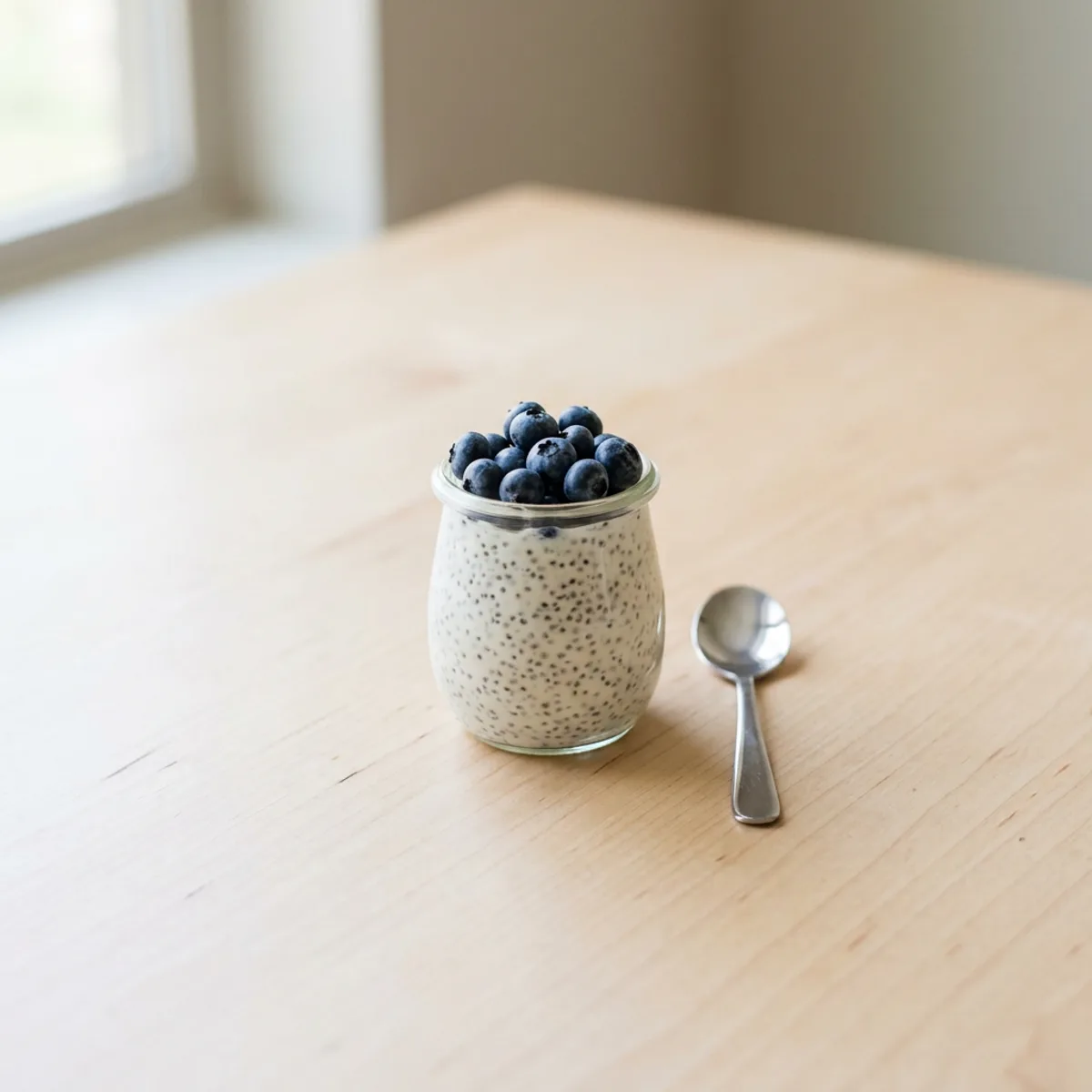
Chia Seed Pudding With Blueberries
Chia is the fiber side of a gut-friendly breakfast, and this pudding sets overnight in the fridge.
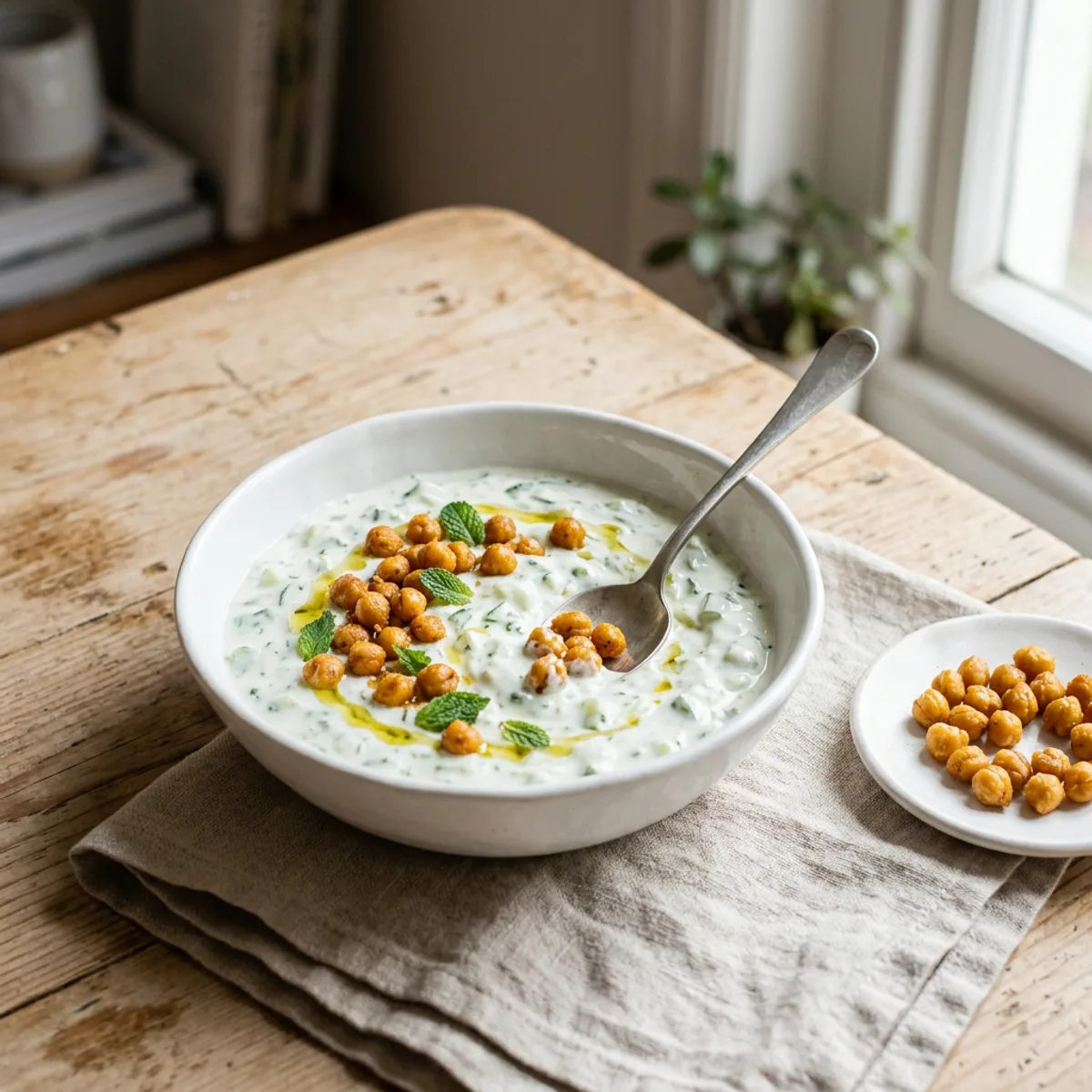
Cucumber-Mint Yogurt Sauce With Crispy Chickpeas
Yogurt is on Harvard's list of probiotic foods, and this page turns it into a cool sauce for crispy chickpeas.
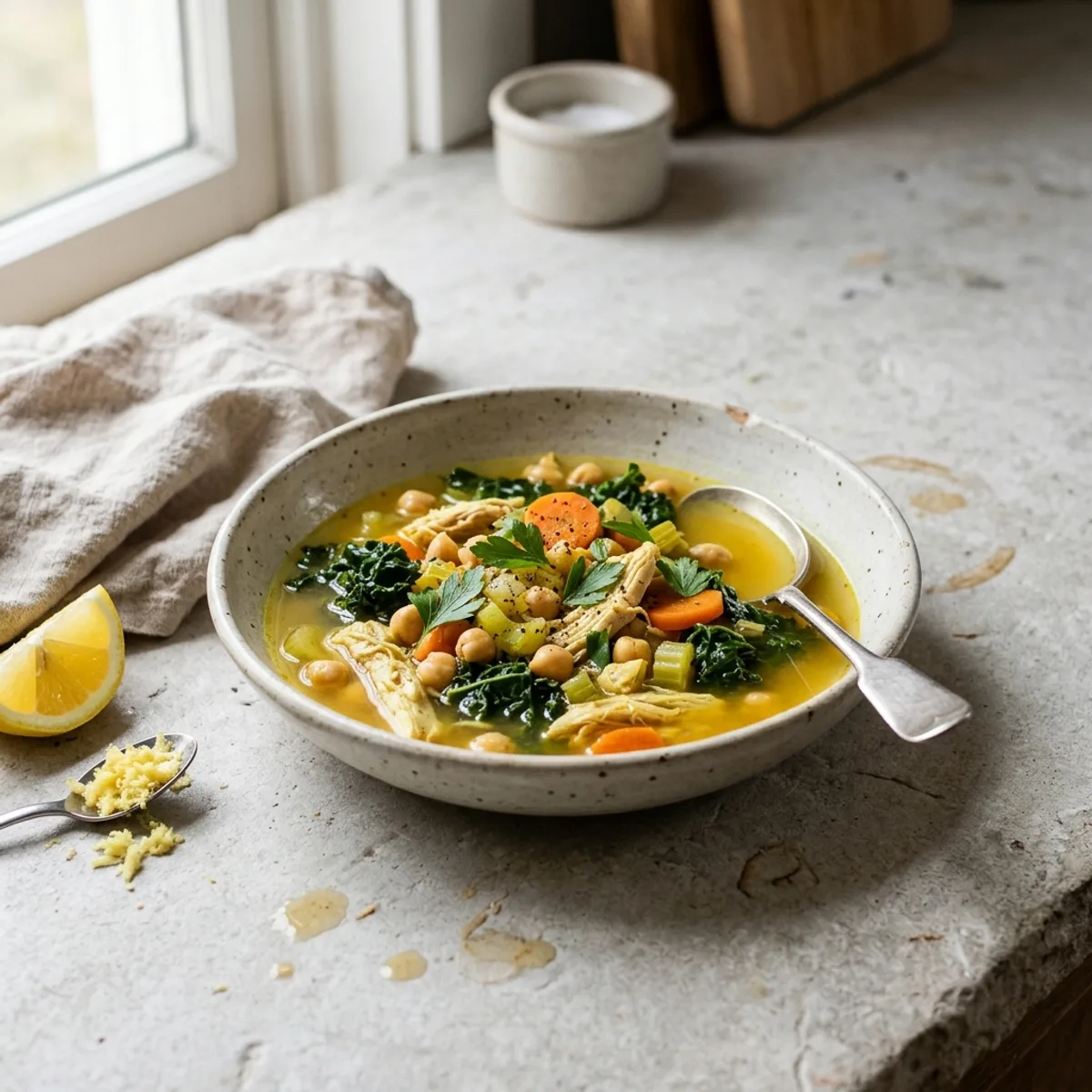
Anti Inflammatory Soup With Turmeric, Ginger, Chicken and Chickpeas
A full pot of soup with chicken and chickpeas for the days a bowl of miso broth is not enough of a meal.
General information, not medical or dietary advice. Nutrition values are estimates. See our full disclaimer.
Frequently asked questions
Are fermented foods healthy for your gut?
Possibly, but the evidence is small. In a 17-week trial of healthy adults, a high-fermented-food diet raised microbiome diversity and lowered inflammatory markers, with 18 people in each arm. Harvard Health calls fermented foods a source of probiotics; it does not promise a result.
What are the super six gut foods?
No official health body we read uses that phrase, so we do not define it. The list on this page comes from Harvard Health's page on probiotic foods, which names ten: yogurt, kefir, kombucha, sauerkraut, pickles, miso, tempeh, kimchi, sourdough bread and some cheeses.
How to tell if food is fermenting in your gut?
None of the sources we read describes a way to tell at home, so we do not offer one. If you have lasting bloating, pain or a change in your bowel habits, bring it to a doctor instead of trying to read it from what you ate.
Can you give me a list of fermented cheeses?
Harvard Health says only that some cheeses are probiotic foods and names none, so we name none either. Whether a cheese still holds live cultures depends on how it was made and heated, so look for live cultures on the label or ask the cheesemaker.

Comments
Tried it? Tell us how it went: your comment helps other readers.