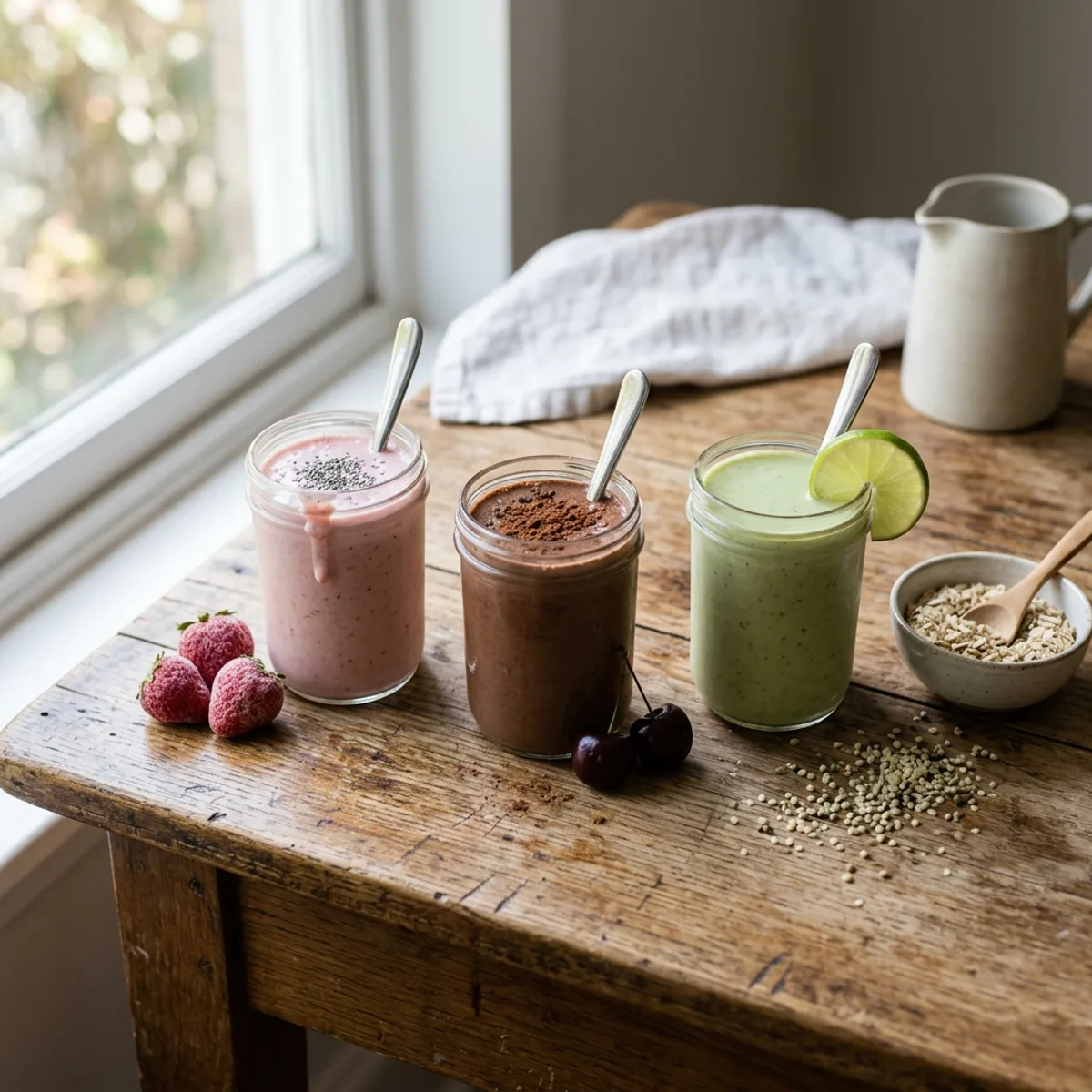
Frozen fruit and a blender do most of the work. These protein smoothies for weight loss each stay under 350 calories with 17 to 24 g of protein: a strawberry-oat whey smoothie (about 340 calories, 9 g of fiber), a chocolate-cherry tofu smoothie and a green kefir-mango one. The trials below explain why we promise no pounds.
What makes a smoothie worth drinking in the morning is the same thing that makes a good plate: something that fills you, something fresh, and nothing that sneaks in a cup of sugar. So each of these protein smoothies for weight loss has a protein base, whole frozen fruit and a spoonful of seeds, and none of them leans on juice, syrup or Greek yogurt.
The three smoothies side by side
| Smoothie | Calories | Protein | Fiber | Protein base | Main caution |
|---|---|---|---|---|---|
| Strawberry-oat whey (recipe card) | About 340 | About 24 g | About 9 g | Whey isolate | Milk and tree nut (almond milk) allergens |
| Chocolate-cherry silken tofu | About 312 | About 21 g | About 8 g | Silken tofu and soy milk | Soy allergen |
| Green kefir-mango | About 286 | About 17 g | About 3 g | Kefir and hemp seeds | Milk allergen |
Figures are estimates worked out from USDA FoodData Central entries for each ingredient. The allergens follow the MedlinePlus list of foods that cause most food allergies.
Why this strawberry-oat smoothie works
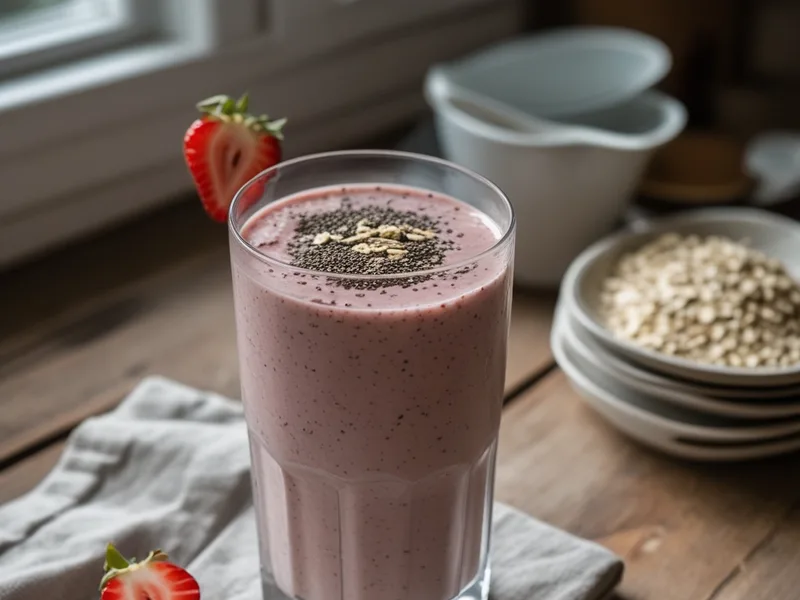
The strawberries go in frozen, which is what makes the glass thick and cold without ice watering it down. Whey isolate brings most of the protein: 30 g of powder gives about 17 g of the 24 g in the glass. Rolled oats and chia seeds are the quiet part of the recipe, and the reason the smoothie has about 9 g of fiber, most of it from the chia (about 4 g) and the strawberries (about 3 g).
Unsweetened almond milk keeps it light, at about 46 calories a cup. If you prefer the taste of milk, use it, and the calories and protein go up. The steps are on the recipe card above. One detail matters more than the rest: liquid and powder go in first, so the protein does not cake against the blade.
Finish with a pinch of chia on top and drink it slowly, at the table, with something to do with your hands other than scroll. A smoothie is still a meal. When you want to chew your lunch or dinner instead, our low calorie meals for weight loss stay between 254 and 343 calories a plate.
High-protein smoothies for weight loss: two more recipes
The recipe card has one smoothie, but nobody wants the same glass every morning, and protein smoothies for weight loss only help if you keep making them. Here are two more, written in full, each built around a different protein so you can rotate them.
Chocolate-cherry silken tofu smoothie
This is the one for people who want dessert at breakfast. Silken tofu blends into something close to a milkshake, and you will not taste it under the cocoa and cherries. It is also the version for a kitchen without dairy. Serves 1.
Ingredients
- 1 cup (243 g) unsweetened soy milk
- 150 g (about 5 oz) silken tofu, firm
- 140 g (about 5 oz) frozen sweet cherries, pitted
- 1 tbsp (5.4 g) unsweetened cocoa powder
- 7 g (about 1 tbsp) ground flaxseed
Steps
- Pour the soy milk into the blender and add the tofu in pieces.
- Add the cherries, cocoa and flaxseed.
- Blend for about a minute, until completely smooth and glossy. Taste, and add a few more cherries if you want it sweeter.
Per glass: about 312 calories, 21 g of protein, 36 g of carbohydrate, 12 g of fat and about 8 g of fiber. The tablespoon of cocoa also carries about 12 mg of caffeine by USDA data, a small amount next to a cup of coffee. Serving idea: pour it into a jar the night before without the cherries, then blend with them in the morning.
Green kefir-mango smoothie
Kefir is tangy, a little fizzy, and it makes a green smoothie taste fresh instead of grassy. Mango brings the sweetness, spinach the color, and hemp seeds most of the extra protein. Serves 1.
Ingredients
- 1 cup (243 g) plain low-fat kefir
- 30 g (about 1 packed cup) baby spinach
- 100 g (about 3.5 oz) frozen mango chunks
- 2 tbsp (20 g) hemp seeds
- 1 tbsp (15 ml) lime juice
Steps
- Put the kefir and spinach in the blender and blend first, for 20 seconds, so no leaf is left whole.
- Add the mango, hemp seeds and lime juice and blend until smooth.
- Finish with a squeeze of lime on top and drink it cold.
Per glass: about 286 calories, 17 g of protein, 31 g of carbohydrate, 13 g of fat and about 3 g of fiber. It has the least fiber of the three; a tablespoon of chia seeds would add about 4 g. If you like greens in a glass but without protein, our green juice recipes for weight loss go the other way.
Nutrition and protein explained, glass by glass
Protein is not the only number that matters in a smoothie. Here is what each one gives you, and where it comes from.
- Protein. 24 g in the whey smoothie, 21 g in the tofu one, 17 g in the kefir one. MedlinePlus puts the recommended protein intake for healthy adults at 10% to 35% of daily calories, and one gram of protein supplies 4 calories. So the 24 g in the strawberry glass is about 96 of its 340 calories (our arithmetic).
- Fiber. Chia, oats, cherries, cocoa and flax do the work here. The whey and kefir add none.
- Carbohydrate. 31 to 43 g, nearly all from whole fruit, milk and oats. No glass has added sugar.
- Fat. 9 to 13 g, mostly from seeds and tofu.
USDA's generic entry for whey isolate lists 58 g of protein per 100 g of powder. Many products on the shelf are higher, so your label wins over our estimate.
Are protein smoothies good for weight loss?
A protein smoothie can be a good breakfast for someone trying to lose weight: it is quick, measured, and you know what is in it. Whether it helps you lose weight is a different question, and the research we read on PubMed gives a careful answer.
- Protein smoothies and the next meal. In a 2019 randomized crossover trial (PMID 30822749), 17 healthy adults drank breakfast smoothies with the same calories, made with whey, with soy, or with carbohydrate and no protein. After the protein smoothies, they rated themselves fuller and ate less at lunch: about 654 calories after whey and 664 after soy, against 769 after the carbohydrate smoothie. Soy did as well as whey. It is one breakfast in a small group, not a diet.
- Drinks versus food. A 2018 trial (PMID 29601488) compared a fruit smoothie with the same fruit eaten whole and with other drinks of equal energy. Fullness rose with how "food-like" the preload felt, but how much people ate afterwards did not differ between the drinks and the food. The study's sponsor, a drinks company, was consulted on its design.
- Smoothie or cereal. In a 2021 trial (PMID 32423255), 25 adults had either cereal and milk or a comparable fruit smoothie for breakfast. Hunger, fullness and what they ate over the next four hours were similar.
- Whey and body weight. A 2023 review (PMID 36543706) concluded that the effects of whey protein in people with overweight, obesity or type 2 diabetes, during calorie restriction or eating freely, are still inconclusive. In a 2021 trial in 12 men with central obesity (PMID 32572617), 20 g of whey taken after a fasted walk lowered blood sugar early after breakfast but did not change appetite or how much they ate at lunch.
- Meal replacements. A 2019 meta-analysis of 23 trials with 7,884 adults (PMID 30675990) found that weight-loss programs using meal replacements led to more weight lost at one year than comparison programs, about 1.4 kg more against other diets. Those are formulated products inside structured programs, not homemade smoothies, and some of the authors held research grants from weight-loss companies.
What this adds up to: a protein-rich smoothie may keep you fuller than a sugary one at the next meal, and a drink is not automatically less filling than food. None of these studies tested a homemade smoothie over months, so the honest promise is a good breakfast, not a number on the scale.
Choosing the best protein powder for smoothies for weight loss
There is no single best powder, and the trials above do not point to a brand. What you can do is read the label well.
- Short ingredient list. Whey isolate, or a plant protein, plus perhaps a flavor. The fewer extras, the easier it is to know what is in your glass.
- Protein per scoop. Check the grams on the label and use that figure rather than ours.
- Added sugar. Choose unflavored or lightly flavored powders and let fruit sweeten the smoothie.
- Whey or soy. In the breakfast trial above, a soy smoothie did as well as a whey one for fullness and lunch intake. Pick the one that suits your diet and allergies.
- No powder at all. The tofu and kefir smoothies get their protein from food, and our high-protein shake builds a glass without any powder.
Best smoothie recipes for weight loss: how to build your own
Once you have the three recipes, you can make your own on the same frame. One cup of unsweetened milk or kefir, one protein (a scoop of powder, 150 g of silken tofu, or seeds), about a cup of frozen fruit, and a spoonful of chia, flax or oats. Leave out juice, which brings sugar without the fiber of whole fruit. Want something lighter between meals? A glass of protein water is thinner and lower in calories. And if a whole smoothie is more than you want in the afternoon, our high protein snacks for weight loss are smaller and need no blender.
Safety: allergies and who should check first
MedlinePlus lists cow's milk, soy and tree nuts such as almonds among the foods that cause most food allergies. Whey and kefir come from milk, tofu and soy milk from soy, and almond milk from a tree nut, so choose the smoothie that fits your diet and swap the milk if you need to. Protein powders are supplements and vary from brand to brand. If you have a medical condition, are pregnant or breastfeeding, follow a special diet or take medicines, talk to your health care provider before you add them.
Storage
These smoothies are best fresh. If you make one ahead, keep it covered in the fridge at 40°F (4°C) or below (USDA cold food storage chart) and drink it the same day; chia and oats thicken it as it sits, so shake or stir in a splash of milk. There is no official shelf life for a homemade smoothie.
How we checked the numbers
- Nutrition: computed from USDA FoodData Central for each ingredient, including whey protein isolate, frozen strawberries, silken tofu, unsweetened soy milk, low-fat kefir and hemp seeds. USDA has no separate entry for frozen cherries or frozen mango, so we used the raw fruit, weighed in grams. The weights of a tablespoon of chia seeds and a cup of almond milk are our assumptions. All totals are estimates.
- Studies: a PubMed search on November 3, 2026 for trials and reviews on whey protein, protein smoothies, meal replacements, fullness and body weight. We read the abstracts and report only what the authors concluded.
- Health guidance: the MedlinePlus pages on protein in diet and food allergy, read on November 3, 2026.
3 Protein Smoothies for Weight Loss, Each Under 350 Calories
A strawberry-oat whey smoothie, a chocolate-cherry silken tofu smoothie and a green kefir-mango smoothie, with protein, fiber and calories worked out from USDA data, and what trials on protein drinks and fullness really show.
Ingredients
Instructions
- Liquid and protein first. Pour the almond milk into the blender, then tip the protein powder on top. Pulse two or three times so the powder disappears into the milk before anything frozen goes in.
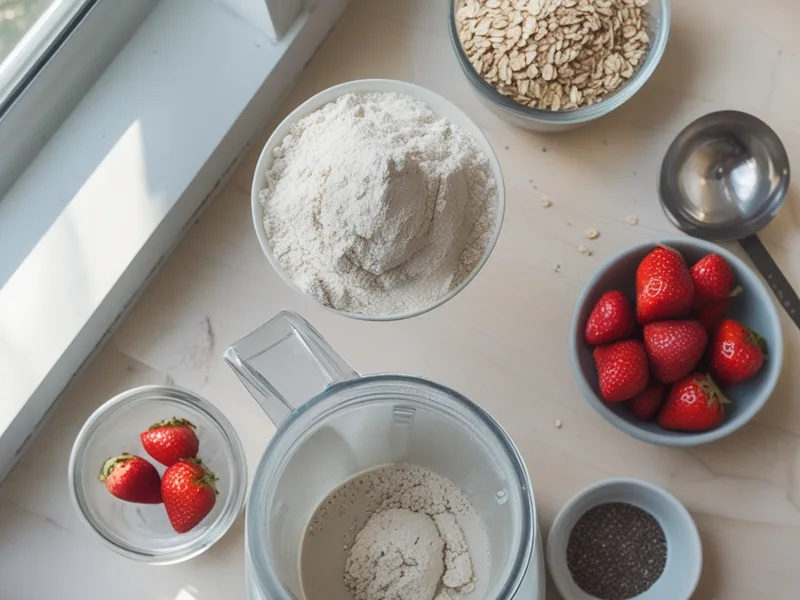
- Add the rest and blend. Add the frozen strawberries, the oats and the chia seeds. Blend on high for 45 to 60 seconds, until no flecks of oat remain and the smoothie folds over itself. Too thick? Add a splash of almond milk and blend again.
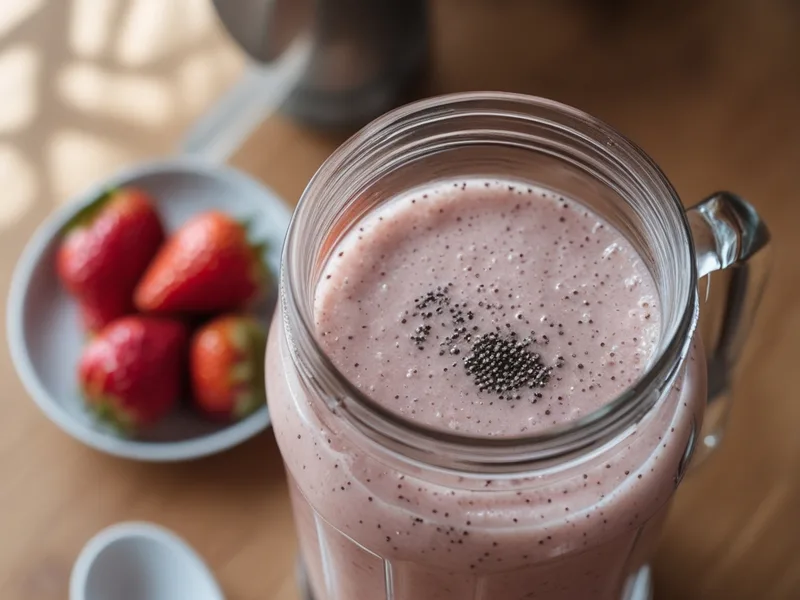
- Pour and serve. Pour into a tall glass and finish with a pinch of chia or a few oat flakes on top. Drink it within the hour, while it is cold and thick. Blended straight from this card with nothing changed, it gave Kerth the texture Kerth was hoping for, quickly and easily, and a glass delicious enough to make again.
Notes
Blend the oats a little longer than you think: raw oats leave a gritty texture if they are not fully broken down.
Whey is made from milk and almond milk from a tree nut. For a version without either, make the chocolate-cherry tofu smoothie further down the page.
Powders differ from brand to brand. If your label gives more protein per scoop than the USDA figure used here, your glass has more protein too.
Nutrition Facts
Per serving (estimated)
- Total Fat
- 9 g
- Sodium
- 260 mg
- Total Carbohydrate
- 43 g
- Protein
- 24 g
General information, not medical or dietary advice. Nutrition values are estimates. See our full disclaimer.
Frequently asked questions
What not to mix with protein?
In the kitchen, the main thing to avoid is hot liquid: whey clumps when it meets heat, so blend it with cold milk or water. For anything medical, such as a kidney condition or a medicine, the answer depends on you, so ask your health care provider.
Which brand of protein shake is best for weight loss?
No brand has been shown to work better than the others for weight, and we do not rank products. Look for a short ingredient list, the grams of protein per scoop and little or no added sugar, then build the rest of the glass from fruit, seeds and milk you choose.
What are some healthy smoothie recipes?
The three on this page are a good start: strawberry-oat with whey (about 340 calories, 24 g of protein), chocolate-cherry with silken tofu (about 312 calories, 21 g) and green kefir-mango (about 286 calories, 17 g). Each pairs protein with fruit and seeds rather than juice or syrup.
What are some recipes I can make with protein powder?
Besides smoothies, protein powder works in a thin protein water, a stir-in for overnight oats, or a shake. Mix it into cold liquids, and count it as part of your protein for the day.
Are protein smoothies good for weight loss?
A protein smoothie can be a filling, measured breakfast, and one small trial found people ate less at lunch after a whey or soy smoothie than after a carbohydrate one. No study we read shows that a homemade smoothie, on its own, makes you lose weight.
Comments
Tried it? Tell us how it went: your comment helps other readers.