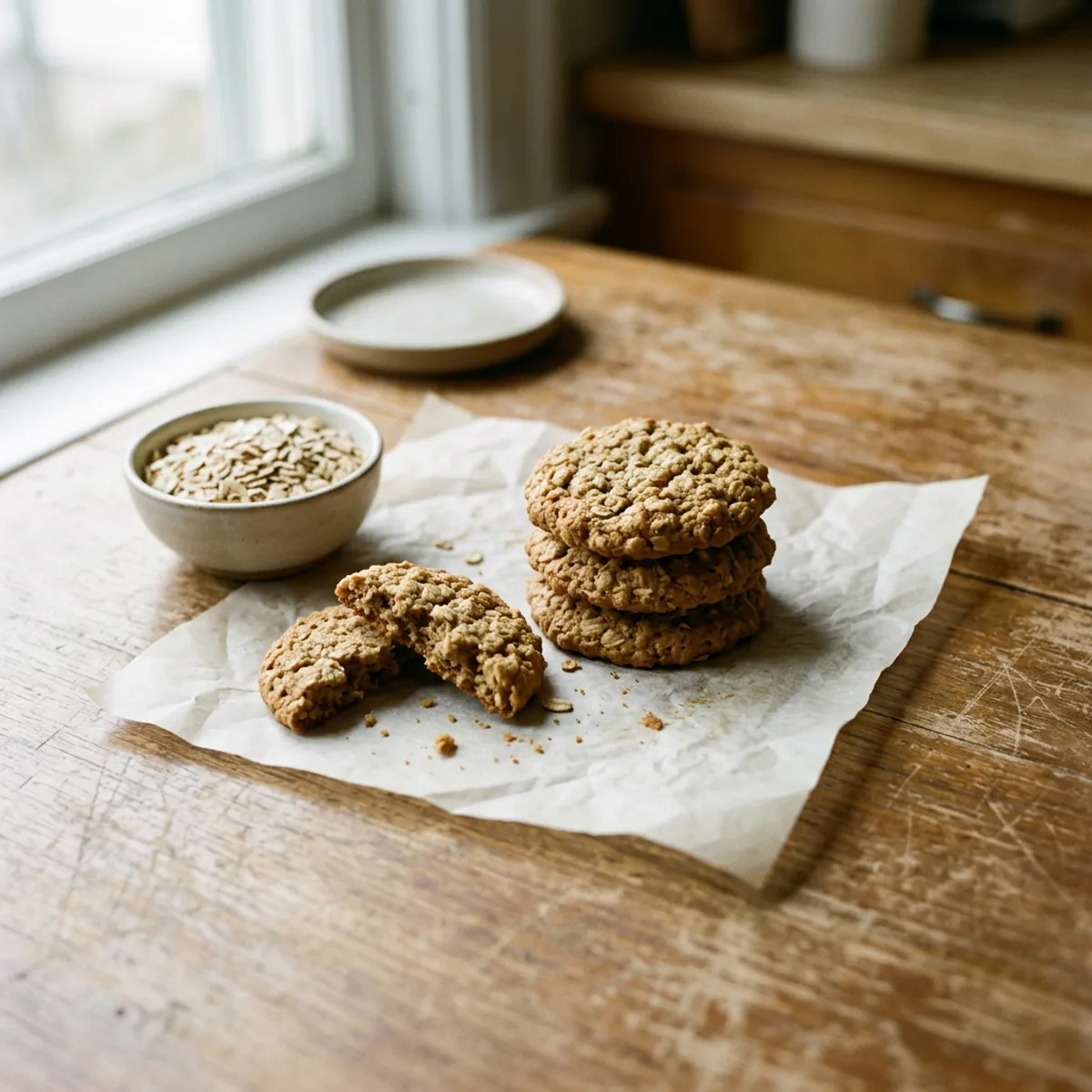
Soft in the middle, golden at the edges, and sweetened with just a third of a cup of maple syrup for the whole batch. These healthy oatmeal cookies need one bowl for the dry ingredients, one for the wet and about 25 minutes. They also settle a question bakers ask all the time: baking soda vs baking powder in cookies, and why this dough has both.
Whisk 1 cup of rolled oats with 3/4 cup of whole wheat flour, baking powder, baking soda and cinnamon, stir in olive oil, maple syrup, Greek yogurt and an egg, scoop 12 cookies and bake at 350°F for 10 to 12 minutes. One cookie has about 102 calories and 3 g of protein by USDA data.
Healthy oatmeal cookies at a glance
| Makes | 12 cookies |
| Time | 10 minutes prep, 10 to 12 minutes baking, 10 minutes cooling |
| Grains | Rolled oats and whole wheat flour |
| Fat | 2 tablespoons of olive oil, no butter |
| Sweetener | 1/3 cup of maple syrup for the batch |
| Per cookie | 102 calories, 3 g of protein (USDA estimate) |
What makes these oatmeal cookies healthy
I would rather give you a straight recipe than a big claim. What is different from a classic oatmeal cookie is simple: rolled oats and whole wheat flour for whole grains, 2 tablespoons of olive oil where a classic recipe uses a stick of butter, a spoonful of Greek yogurt for moisture, and maple syrup as the only sweetener. A cookie is still a cookie. The numbers below tell you exactly what a portion holds.
Baking soda vs baking powder in cookies
This dough uses both, in small amounts, and each has a job.
- Baking soda is pure sodium bicarbonate. It needs an acid to react, and here the Greek yogurt supplies it. It also helps baked goods brown, which gives these cookies their golden edges.
- Baking powder is baking soda plus a dry acid and a starch. It needs only liquid and releases its gas in stages, so it gives the cookies a little extra lift without depending on an acid.
- Why not more? Baking soda is 3 to 4 times stronger than baking powder. Too much baking soda for the amount of acid leaves a metallic, soapy taste, so a recipe uses only a pinch.
Many cookie doughs lean on baking soda because they contain brown sugar, honey or molasses, which are mildly acidic. A dough without an acid, such as a plain sugar cookie, usually relies on baking powder. For the full comparison, a swap chart and a freshness test, see our Greek yogurt pancakes, which explain the two in detail. If you wonder how much baking soda is safe to eat, our guide on whether you can drink baking soda covers it.
How to make healthy oatmeal cookies
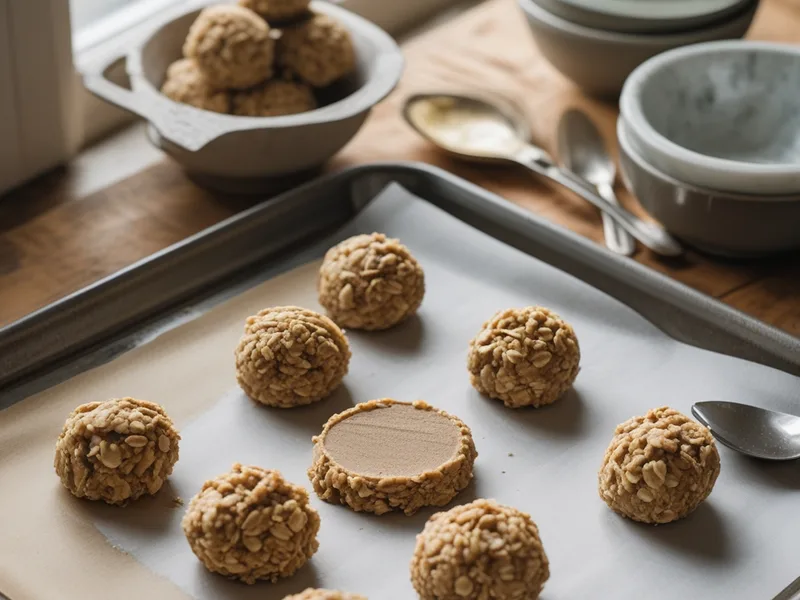
The recipe card has the steps and photos. Three details matter: whisk the dry ingredients so the leaveners are even, stir the dough only until the flour disappears, and let it rest for 5 minutes so the oats drink in some of the liquid. Flatten the scoops a little, because this dough does not spread much.
Nutrition: how many calories in an oatmeal cookie
The nutrition figures come from USDA FoodData Central values. One cookie, one twelfth of the batch, has about 102 calories, 3 g of protein, 16 g of carbohydrate and 3 g of fat, with about 79 mg of sodium. The values are estimates: the cup weights are documented assumptions, and your brands will move the numbers a little. This is not a promise of any health effect, and the cookies are a treat, not a diet food.
Healthy chocolate chip cookies oatmeal: a variation
Fold in a small handful of dark chocolate chips after the dough comes together, and press a few on top. Chocolate chips add calories and sugar to each cookie, so treat the numbers above as the plain version. Add-ins stay light when you measure them: a tablespoon or two per batch is plenty.
Variations and substitutions
- Flour: swap the whole wheat flour for all-purpose flour for a lighter, softer cookie, or for a 1 to 1 gluten-free baking flour if you avoid gluten. Check the label of any oats you use, too.
- Sweetener: honey can replace the maple syrup in the same amount; the dough tastes a little different.
- Spice: a pinch of nutmeg next to the cinnamon.
- Add-ins: raisins, chopped nuts or dark chocolate chips, in small amounts.
- Egg-free: we keep the egg in this recipe.
Tips and common mistakes
- Do not over-mix. Stir until the dry flour disappears.
- Rest the dough 5 minutes. The oats soak up liquid and the dough is easier to scoop.
- Use fresh leaveners. Old baking powder and baking soda give flat cookies.
- Space the scoops 2 inches (5 cm) apart, and flatten them slightly, because they will not spread much.
- Cool on the pan for 10 minutes, so the cookies set before you move them.
- Troubleshooting dry cookies: they were baked too long. Take them out when the edges are golden, as they firm up while cooling.
- Troubleshooting flat cookies: old leavener, or too much liquid. Check the freshness of your baking powder and measure the maple syrup level.
- Troubleshooting a soapy taste: too much baking soda. Measure it level.
Delicious, says Emma of the cookies, with the texture Emma hoped for. Baked exactly as written with little effort, and Emma would bake them again.
Serving ideas
A cookie and a glass of milk is the classic. For breakfast on the go, pair one with a Greek yogurt parfait, or bake a loaf of our pumpkin bread the same day: both use whole wheat flour and a small amount of baking soda.
Storage and freezing
Cool the cookies completely. Sources for similar oatmeal cookies say they keep up to 1 week at room temperature, away from heat and sunlight, and that you can freeze them in a freezer-friendly container after cooling. We found no official shelf life, so use your judgment. Reheat a frozen cookie for a few seconds in the microwave or a few minutes in a warm oven.
Safety: allergens and gluten
These cookies contain eggs, wheat (gluten) and dairy (Greek yogurt). Oats can be cross-contaminated with gluten, so check the label if you avoid it. With diabetes or a similar condition, a doctor or registered dietitian can say how a recipe like this fits your plan. Bake until the centers are set, because the dough contains raw egg.
Nutrition values are estimates.
Sources and numbers
- Baking soda and baking powder: the roles and strengths come from Arm & Hammer and NC State University News.
- Nutrition: values come from USDA FoodData Central for each ingredient; the cup weights are documented assumptions, so the total stays an estimate.
Healthy Oatmeal Cookies That Are Soft, Chewy and Around 100 Calories Each
Soft oatmeal cookies made with rolled oats, whole wheat flour, olive oil, Greek yogurt and maple syrup, with USDA numbers per cookie, plus what baking soda and baking powder each do in a cookie.
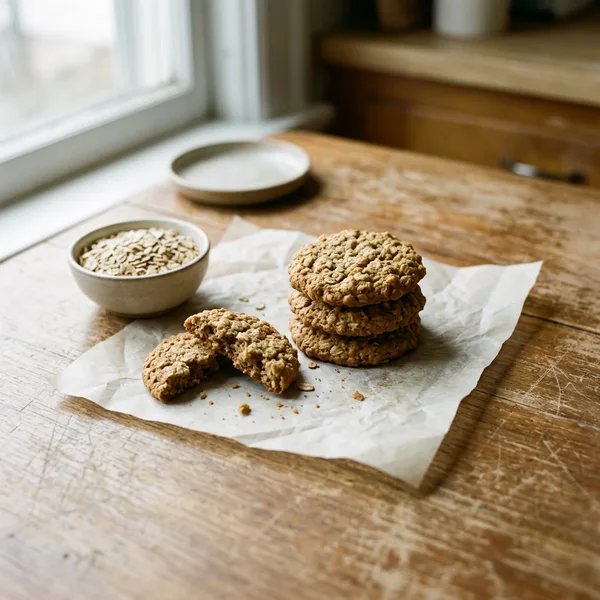
Ingredients
Instructions
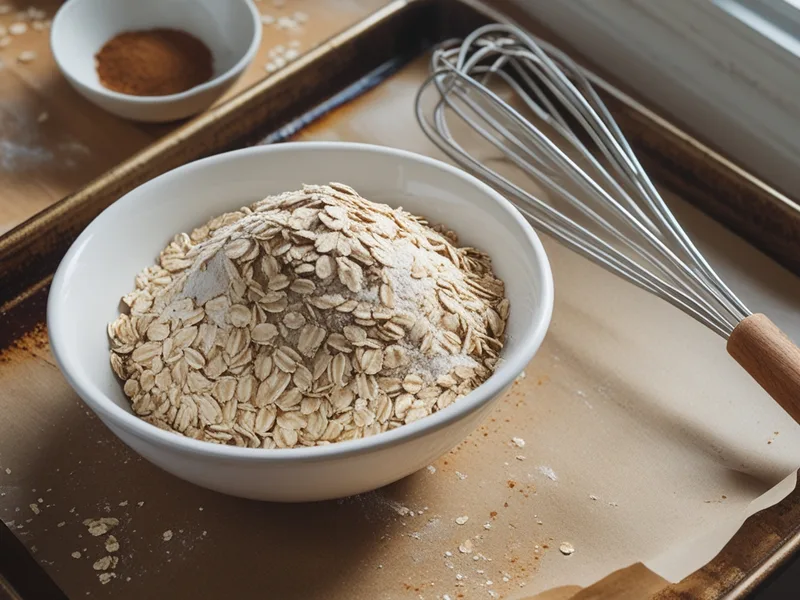
- Heat the oven and mix the dry ingredients. Heat the oven to 350°F (175°C) and line a baking sheet with parchment paper. In a medium bowl, whisk the oats, whole wheat flour, baking powder, baking soda, cinnamon and salt, so the leaveners spread evenly.
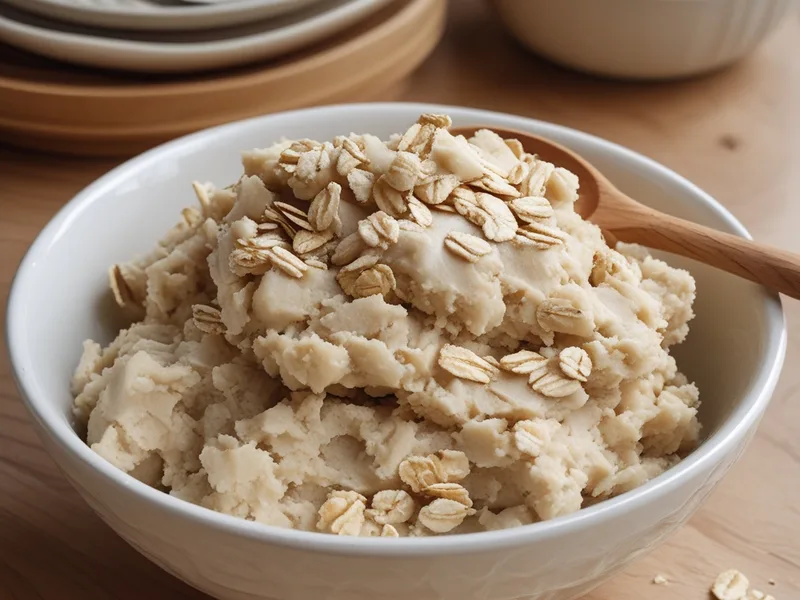
- Whisk the wet ingredients and combine. In a large bowl, whisk the olive oil, maple syrup, Greek yogurt, egg and vanilla until smooth. Add the dry mix and stir just until no dry flour is left. Let the dough rest for 5 minutes so the oats absorb some of the liquid.
- Scoop and bake. Scoop 12 rounded tablespoons of dough onto the baking sheet, 2 inches (5 cm) apart, and flatten each one gently with the back of a spoon or a fork. Bake for 10 to 12 minutes, until the edges are golden and the centers look set. Cool on the pan for 10 minutes before moving to a rack.
Notes
The dough is soft and sticky. If it will not hold a shape, rest it 5 more minutes or stir in a tablespoon of oats.
The baking time is a range: ovens differ, so judge by the golden edges. The cookies firm up as they cool.
Nutrition Facts
Per serving (estimated)
- Total Fat
- 3 g
- Sodium
- 79 mg
- Total Carbohydrate
- 16 g
- Protein
- 3 g
General information, not medical or dietary advice. Nutrition values are estimates. See our full disclaimer.
Frequently asked questions
What is the healthiest oatmeal cookie you can eat?
There is no single healthiest cookie, but you can tilt the recipe. This one uses rolled oats, whole wheat flour, olive oil instead of a stick of butter, and a third of a cup of maple syrup for 12 cookies. How a cookie fits your day still depends on portion and the rest of your meals.
Are oatmeal cookies the healthiest?
Not automatically. A bakery oatmeal cookie can be as high in sugar and fat as any other cookie. What changes the picture is the recipe: whole grains, less added sugar and a modest amount of fat. Check the numbers, as we do here with USDA data.
Is it possible to make healthy oatmeal cookies?
Yes. Use rolled oats and part or all whole wheat flour, replace most of the butter with a little olive oil and yogurt, and keep the sweetener modest. This recipe does exactly that. A cookie is still a treat, so enjoy it in a portion that suits you.
How do I make 3 ingredient oatmeal cookies?
We do not give a 3 ingredient version. Cookies with so few ingredients are very simple and tend to be denser and less sweet, and we prefer to give you a recipe whose numbers we have calculated. This one keeps the list short and the steps easy.

I’m Emma Bloom, founder and editorial voice behind Eat & Bloom. I share approachable recipes, practical nutrition tips and simple food ideas for everyday life, and I believe eating well should not be complicated or restrictive. Eat well. Find what works for you. Bloom.
Comments
Tried it? Tell us how it went: your comment helps other readers.