Collagen rich foods are animal foods with connective tissue: tough cuts of beef such as brisket and chuck, the skin and bones of fish, bone broth and gelatin. No plant contains collagen, but peppers, tomatoes, citrus, legumes, seeds and whole grains supply the vitamin C and zinc your body uses to make its own.
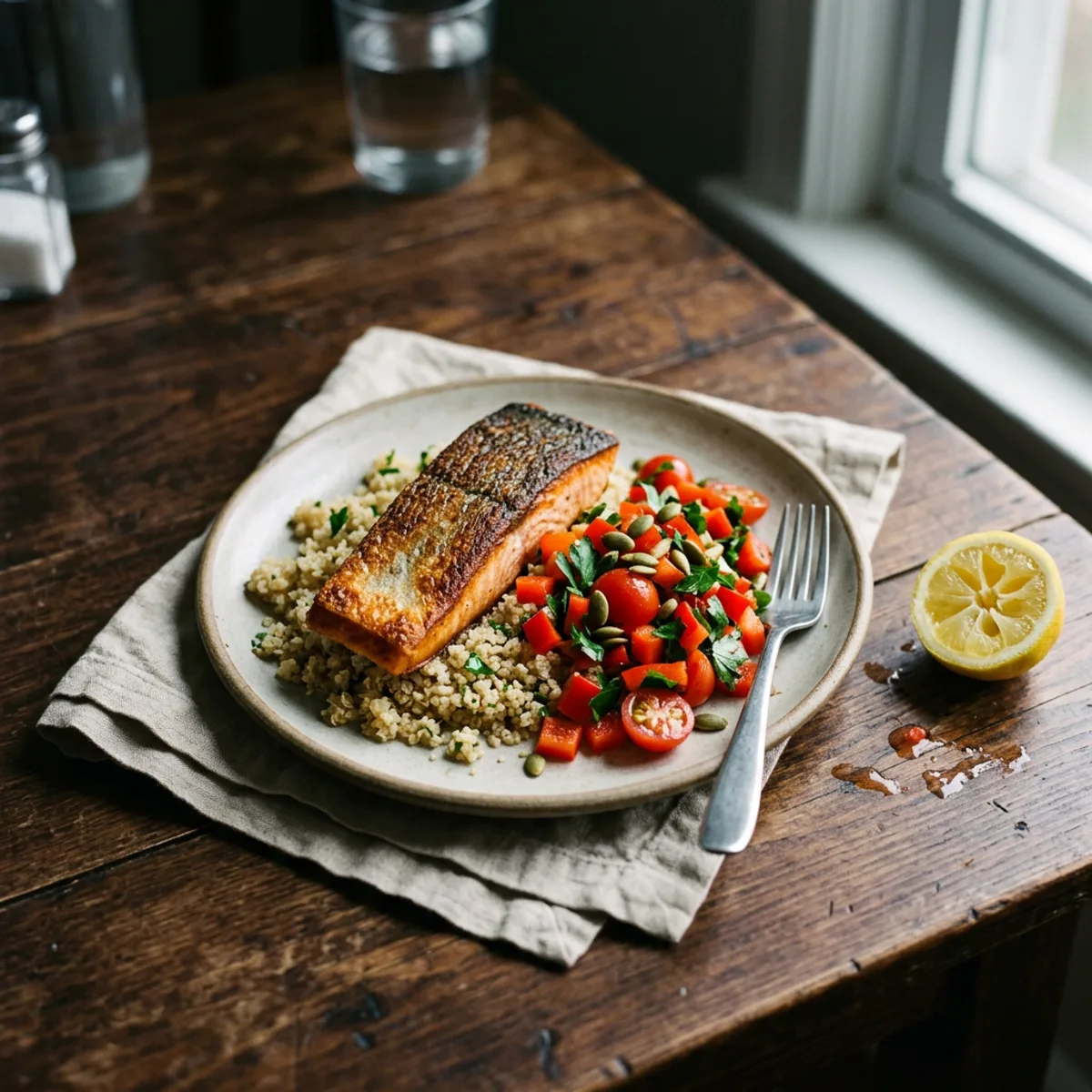
This plate puts both halves together. Salmon goes into the pan skin side down and stays there until the skin is as crisp as a cracker, because that skin is the part with the collagen, and it is a shame to leave it on the plate. Next to it, a raw salsa of red pepper, cherry tomatoes, parsley and lemon, a bed of quinoa and a handful of toasted pumpkin seeds. Thirty-five minutes from start to finish, and every quantity is in the recipe card.
| If you searched for | What it means on a plate | What the evidence shows | Main caution |
|---|---|---|---|
| What foods are rich in collagen | Tough cuts like pot roast, brisket and chuck steak, fish skin and bones, bone broth, gelatin | No trial has tested eating these foods for skin | Harvard does not recommend a high intake of red meat |
| Natural foods rich in collagen | The same foods, as opposed to powders and pills | Independent trials of collagen supplements found no skin effect (2025 meta-analysis) | The FDA does not review supplements before they are sold |
| Collagen rich foods for skin | Fish skin in this recipe, plus raw vitamin C foods | Vitamin C is needed to form collagen (MedlinePlus) | Food does not undo sun damage or smoking |
| Collagen rich foods list | 5 foods that hold collagen, 3 groups that help you make it (below) | Lists come from Harvard's Nutrition Source | Bone broth varies a lot from batch to batch |
| Collagen rich foods vegetarian | None: plants have no collagen, only its helpers | No study of plant foods and skin collagen found | Choose legumes, soy, seeds and whole grains for protein and zinc |
| 8 collagen rich foods | The list below, by what each one brings | Most collagen research is on supplements, not food | Supplement labels may not match the contents |
What foods are rich in collagen?
Harvard's Nutrition Source is plain about it: in food, collagen is found only in animal flesh that contains connective tissue. That means the cuts that need long, slow cooking to turn tender, like pot roast, brisket and chuck steak, and the bones and skin of fish, from the sea or fresh water. Bone broth and gelatin are made by boiling bones, cartilage and skin for hours.
The same page adds a point that changes how to shop. Collagen you eat does not travel to your skin as collagen. In the stomach it is broken down into amino acids, which the body sends wherever it most needs protein. So the useful question is not only which foods hold collagen, but which ones give your body what it needs to build its own: protein, vitamin C and zinc.
Collagen rich foods list: 8 collagen rich foods and what each one brings
The first five foods contain collagen. The last three contain none, but Harvard names them as sources of what collagen production needs.
| Food | What it brings | Worth knowing |
|---|---|---|
| Pot roast, brisket and chuck steak | Collagen from connective tissue | Harvard does not recommend a high intake of red meat |
| Fish skin, as on this salmon | Collagen | Ask for scaled fillets and cook it crisp |
| Fish bones, as in canned sardines with their bones | Collagen | Canned fish can be salty: read the label |
| Bone broth | Collagen precursors, in small and variable amounts | 5 to 10 g of protein per cup, according to Harvard |
| Gelatin | A form of collagen, from boiled bones, cartilage and skin | Sets liquids; see our sugar-free gelatin |
| Legumes and soy | The amino acids collagen is built from, and zinc | The vegetarian route |
| Nuts, seeds and whole grains | Zinc | The pumpkin seeds and quinoa on this plate |
| Bell peppers, citrus, berries, tomatoes and leafy greens | Vitamin C | Eat some raw: cooking lowers vitamin C |
A word on bone broth, since it is sold as the collagen food. Harvard describes the method, bones simmered in water with a little vinegar for 4 to 24 hours, and warns that the amount of amino acids changes with the bones, the cooking time and the processing. A 2019 laboratory study measured it and agreed (more on that below).
Natural foods rich in collagen or a powder?
Powders and pills are sold as collagen peptides or hydrolyzed collagen. Harvard notes that most of the research on them is funded, at least in part, by the industries that sell them, that a supplement may not contain what its label says, and that some have raised concerns about heavy metals. In the United States, the FDA does not review supplements for safety or effectiveness before they reach the shelf.
Food has the advantage of bringing more than one thing at a time. This plate gives you the fish skin, a full serving of protein, raw vitamin C from the salsa and zinc from the seeds and the quinoa.
What the collagen trials found
We read these abstracts on PubMed on November 6, 2026. None of them tested a food: they all gave people collagen powders or drinks, or analysed broth in a lab.
- The pooled trials, 2021. A meta-analysis in the International Journal of Dermatology (PMID 33742704) combined 19 trials and 1,125 people aged 20 to 70, 95% of them women. Hydrolyzed collagen did better than a placebo on skin hydration, elasticity and wrinkles, and the authors concluded that 90 days of it reduces signs of skin aging.
- A larger pool, 2023. In Nutrients (PMID 37432180), 26 trials and 1,721 people: collagen improved hydration and elasticity compared with a placebo, but the authors found several biases in the trials and asked for larger ones before calling it settled.
- Sorted by who paid, 2025. A meta-analysis in The American Journal of Medicine (PMID 40324552) took 23 trials and 1,474 people and split them by funding. All together, collagen looked helpful. The trials without funding from the companies found no effect on hydration, elasticity or wrinkles, and neither did the high-quality trials. The authors concluded that no clinical evidence supports collagen supplements to prevent or treat skin aging.
- Bone broth in the lab, 2019. In the International Journal of Sport Nutrition and Exercise Metabolism (PMID 29893587), researchers measured the amino acids of homemade, café and store-bought bone broths. Made to a standard recipe, broth had far less glycine, proline and hydroxyproline than the 20 g dose of collagen used in research, and broths made without a set recipe varied widely. The authors judged broth unlikely to be a reliable source.
- Vitamin C and skin, 2017. A review in Nutrients (PMID 28805671) explains that normal skin holds a lot of vitamin C, which stimulates collagen synthesis and helps protect against UV damage. It also says that it is poorly understood whether vitamin C on the skin does better than enough of it in the diet. A kiwifruit company, Zespri, partly funded it and is declared as having had no influence.
Funding changes the answer
Read together, these papers point one way. The positive results for collagen come mostly from trials paid for by the people selling it; the independent and better-run trials do not show a skin effect. And eating collagen-rich food has simply not been tested for skin. What is well established is more modest: your body makes collagen from protein and needs vitamin C to do it.
Collagen rich foods for skin and hair, and glowing skin
"Glowing skin" is not something these trials can measure, and no food has been shown to deliver it. What food can do is cover the raw materials. MedlinePlus lists forming collagen, the protein used to make skin, tendons, ligaments and blood vessels, among the jobs of vitamin C, along with healing wounds. The body does not store vitamin C, and MedlinePlus says the best sources are raw fruit and vegetables, which is why the salsa never sees the heat.
The habits matter as much as the plate. Harvard lists sun, smoking and too little sleep and exercise among the things that make collagen production drop fastest.
Collagen rich foods for hair growth
No study we read tested collagen foods, or collagen powder, on hair. MedlinePlus does list crash diets, especially those without enough protein, among the causes of hair loss. A plate like this one, with a full serving of protein, fits the "enough protein" side of that. Hair loss has many other causes, from illness to hormones, so a doctor is the right person to find out which one applies. For more on food and hair, our foods for hair growth recipes start from salmon too.
Making crispy skin salmon that tastes like it should
Good salmon skin should shatter when you put a fork to it, and the flesh under it should still be pink and moist in the middle of the cooking time. Three things get you there.
- Buy well. Look for fillets of even thickness, about 2.5 cm (1 inch), with the skin on and the scales removed. Thin tail pieces overcook before the skin is crisp.
- Dry the skin. Paper towels, both sides, right before the pan. Season only the flesh: salt on the skin pulls out water.
- Leave it alone. Press the fillets flat for 10 seconds so the skin does not curl, then do not touch the pan. When the skin is ready, it releases by itself.
Finish at 145°F (63°C) in the thickest part, the safe temperature for fish given by the USDA Food Safety and Inspection Service. Serve skin side up: on the quinoa, it would steam and soften.
For the salsa, cut the pepper small, about 5 mm, so every spoonful gets some of everything. It tastes right when it is sharp from the lemon and a little sweet from the tomatoes; if it tastes flat, it needs a pinch more salt or another squeeze of lemon, not more oil.
On November 6, Bogdan cooked the plate straight from the card, nothing changed; it came out delicious, with exactly the texture Bogdan wanted, and it is one Bogdan plans to cook again.
Nutrition per plate
The recipe makes 4 plates. Each one has about 553 calories, 37 g of protein, 31 g of carbohydrate, 31 g of fat and 384 mg of sodium, with about 6 g of fiber, 2.3 mg of zinc and 112 mg of vitamin C. Most of the fat comes from the salmon itself and the olive oil.
These are estimates, added up from the USDA record of each raw ingredient. The vitamin C is counted from the raw pepper, tomatoes, parsley, lemon and salmon; it stays close to that in the salsa because nothing there is cooked. The USDA records for quinoa and pumpkin seeds give no vitamin C value, so they add none here, while they supply most of the zinc along with the salmon.
Swaps that keep the idea
- Trout or arctic char instead of salmon. Both are sold with the skin on and cook a little faster.
- Canned sardines with their bones, warmed in the pan, for a no-cook version of the fish.
- Farro or bulgur instead of quinoa; both are whole grains.
- Sunflower seeds instead of pumpkin seeds.
- Yellow or orange bell pepper in the salsa if that is what looks best at the store.
If you prefer your collagen in a glass, our collagen smoothie blends strawberries and banana with collagen peptides, and the roasted vegetable bowl in foods for clear skin is another plate built on red pepper.
Safety and who should be careful
- Supplements are not checked before sale. The FDA does not review dietary supplements for safety or effectiveness before they are sold, and Harvard raises concerns about heavy metals in some collagen supplements (Harvard Nutrition Source, Collagen). Harvard also notes that the trials have not shown side effects in the people who took them.
- Bone broth and metals. Harvard cites a small study that found three times as much lead in broth made from chicken bones as in broth made from the meat, still below half of what the EPA allows in drinking water, and another that found lead and cadmium in homemade and store-bought broths.
- Red meat. The tough cuts that hold the most collagen are red meat, and Harvard does not recommend a high intake of it for long-term health.
- Fish temperature. Cook fish to 145°F (63°C) (USDA FSIS, Safe Minimum Internal Temperature Chart).
- Vitamin C pills. MedlinePlus advises against more than 2,000 mg a day from supplements, which can upset the stomach and cause diarrhea (MedlinePlus, Vitamin C). The salsa is nowhere near that.
- Allergies. This recipe contains fish.
A rash, a wound that will not heal or sudden hair loss belongs with a doctor, not with a new diet.
How we checked the numbers
- Nutrition: USDA FoodData Central records for raw farmed Atlantic salmon, quinoa, red bell pepper, grape tomatoes, fresh parsley, garlic, lemon juice, olive oil, pumpkin seeds and salt, added up by ingredient. The salmon record does not say whether the skin is included, so the figures are an estimate.
- Studies: the five papers linked above, found through PubMed and read in abstract form on November 6, 2026.
- Official pages: Harvard's Nutrition Source on collagen, MedlinePlus on vitamin C and on hair loss, and the USDA FSIS safe temperature chart, read on November 6, 2026.
Collagen Rich Foods on One Plate: Crispy Skin Salmon, Red Pepper Salsa and Quinoa
Salmon cooked skin side down until the skin cracks like a chip, a raw salsa of red pepper, tomato, parsley and lemon, quinoa and toasted pumpkin seeds. Which foods really hold collagen, which ones help you make your own, and what the collagen trials found once funding was taken into account.
Ingredients
Instructions
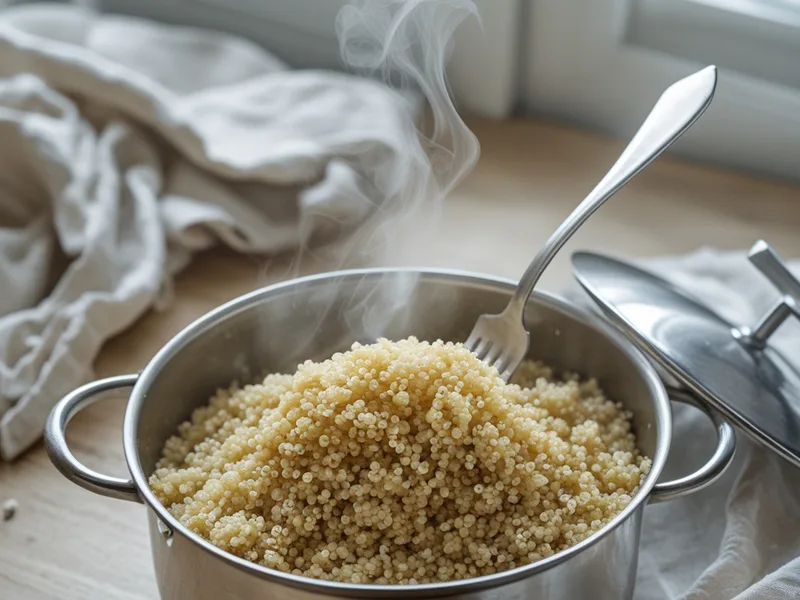
- Cook the quinoa. Put the rinsed quinoa in a small pot with 1 1/2 cups (360 ml) of water. Bring to a boil, cover, turn the heat to low and simmer for 15 minutes. Take the pot off the heat and leave it covered for 5 minutes, then fluff it with a fork.
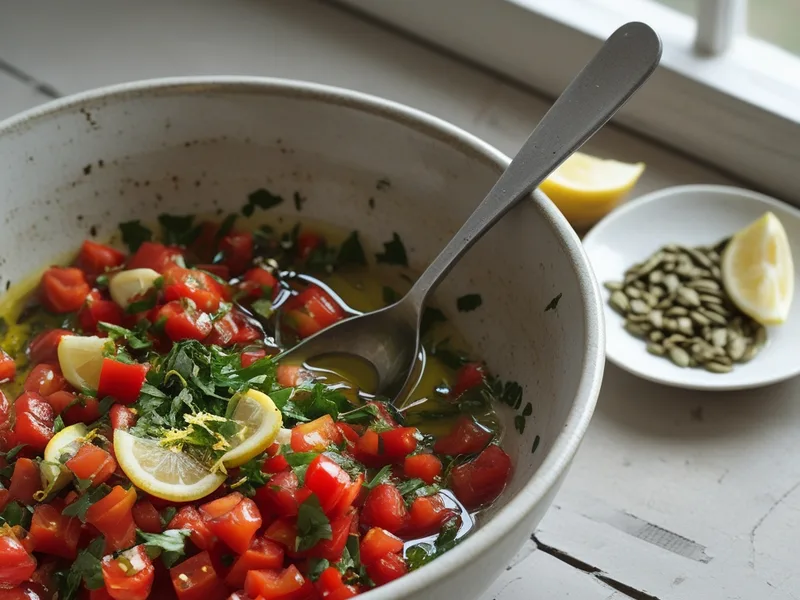
- Make the raw salsa. While the quinoa cooks, toss the diced pepper, tomatoes, parsley, garlic, lemon juice, lemon zest, 1 1/2 tablespoons of the olive oil and 1/4 teaspoon of the salt in a bowl. Toast the pumpkin seeds in a dry 12 inch (30 cm) skillet over medium heat for 2 to 3 minutes, until they puff and start to pop, then tip them onto a plate.
- Sear the salmon skin side down. Pat the fillets very dry with paper towels, skin included. Season the flesh side with the rest of the salt and the black pepper. Heat the last 1/2 tablespoon of oil in the same skillet over medium-high heat until it shimmers. Lay the fillets in skin side down, press each one flat with a spatula for 10 seconds, then leave them alone for 5 to 6 minutes, until the skin lets go of the pan by itself and the flesh has turned opaque about two thirds of the way up.
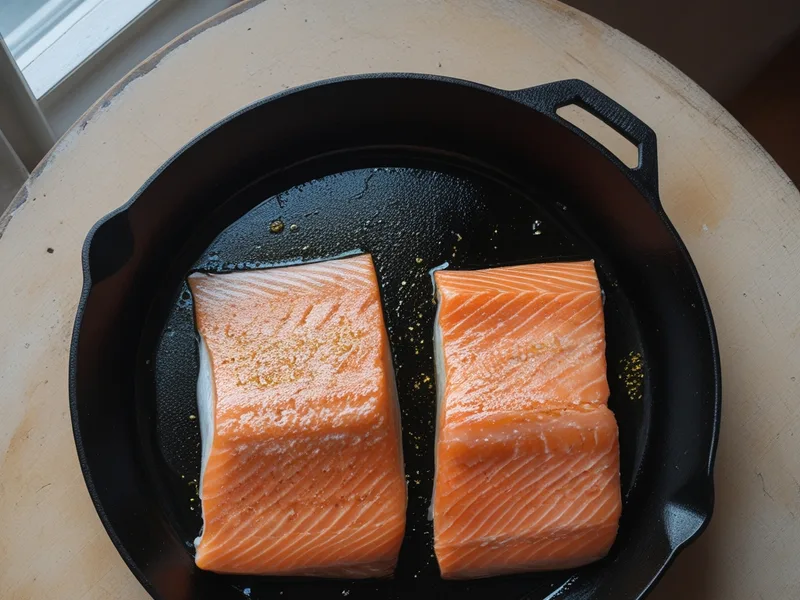
- Finish and serve. Turn the fillets and cook for 1 to 2 minutes more, until the thickest part reads 145°F (63°C) on an instant-read thermometer. Spoon the quinoa onto plates, set the salmon on top skin side up so it stays crisp, and serve the salsa and the pumpkin seeds alongside.
Notes
Dry skin is crisp skin. Any water left on it steams instead of frying, and the fillet will stick.
Ask for scaled fillets, or run the back of a knife against the grain of the skin under cold water until no scales come off.
The salsa stays raw on purpose: cooking reduces vitamin C. It is best eaten the day you make it.
Nutrition Facts
Per serving (estimated)
- Total Fat
- 31 g
- Sodium
- 384 mg
- Total Carbohydrate
- 31 g
- Protein
- 37 g
General information, not medical or dietary advice. Nutrition values are estimates. See our full disclaimer.
Frequently asked questions
What is collagen?
Collagen is the most abundant protein in the body, according to Harvard's Nutrition Source. Its fibers build connective tissue and are a major part of bone, skin, muscles, tendons and cartilage, which they keep strong and able to stretch.
Does banana have collagen?
No. Harvard explains that in food, collagen is found only in animal flesh that contains connective tissue, so no fruit has any. Fruit can still help your body make its own: vitamin C, found in citrus, berries, bell peppers and tomatoes, is needed to form collagen.
How to make collagen at home?
Your body makes collagen itself from the protein you eat, with help from vitamin C and zinc. In the kitchen, the closest thing is bone broth, made by simmering bones in water with a little vinegar for 4 to 24 hours, but a 2019 lab analysis found its amino acid content low and variable.
What depletes collagen the most?
Harvard notes that the body makes less collagen with age, and among the things that make production drop fastest it names too much sun exposure, smoking, and a lack of sleep and exercise. It adds that chronically high cortisol, the stress hormone, can lower collagen production too.
Are there vegetarian collagen rich foods?
No plant food contains collagen. Legumes and soy provide the amino acids collagen is made of, nuts, seeds and whole grains provide zinc, and peppers, citrus, berries and leafy greens provide vitamin C, all of which your body uses to build its own.
Comments
Tried it? Tell us how it went: your comment helps other readers.